Ocean Freight Billing Terms: Common Charges and What They Mean
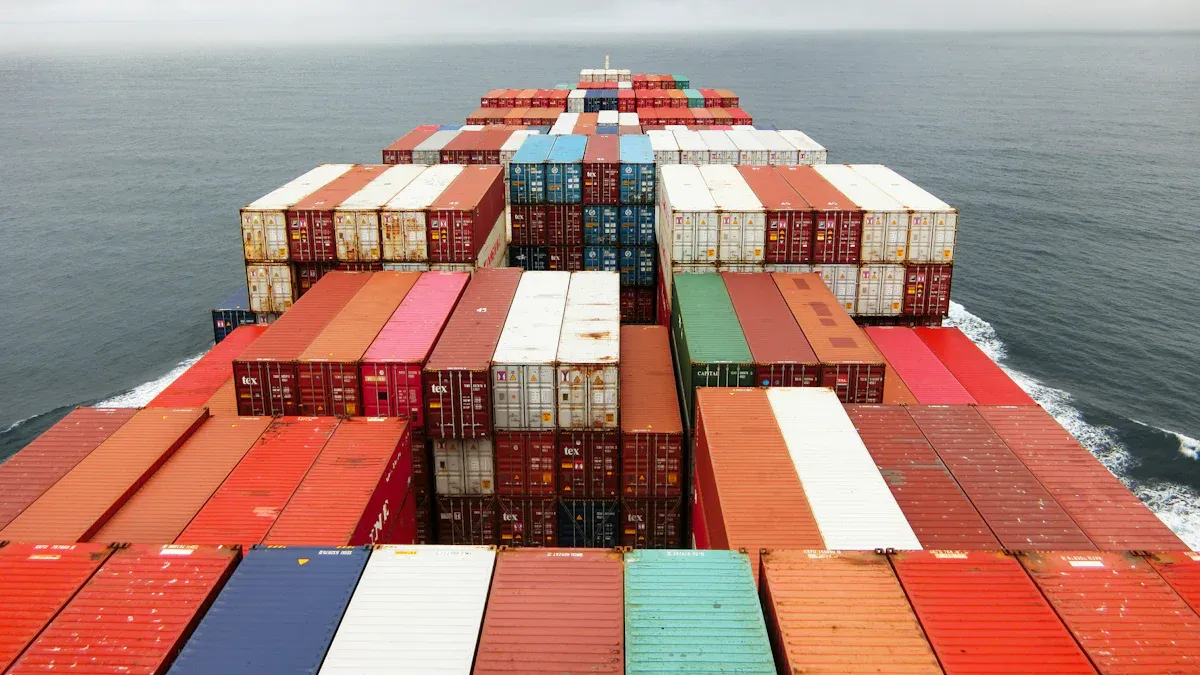
You face real problems when you try to understand ocean freight billing terms. More than 80% of world trade uses ocean shipping. Even small mistakes can cost you money. Many ocean freight charges show up on bills. These include customs security surcharges, terminal handling, insurance, and accessorial fees. If you do not understand these charges, you might pay late. You could spend too much or argue with partners. Looking closely at each freight bill helps you avoid expensive mistakes. It also keeps your shipping budget safe.
Mistakes in billing can slow down payments and hurt business friendships. Being clear is important for planning your money.
Key Takeaways
Know main ocean freight charges like Base Ocean Freight Charge and Terminal Handling Charge. This helps you avoid surprise costs. Check your ocean freight bills often to find errors. Make sure you do not pay too much. Learn about extra fees like Peak Season Surcharge and Demurrage. This helps you plan your shipping budget well. Get to know Incoterms to see who pays for different shipping costs. This helps you avoid surprise fees. Work with freight forwarders to learn more about shipping rates. They can help you get better deals.
Key Ocean Freight Billing Terms
Knowing ocean freight billing terms helps you avoid mistakes. It also helps you keep your shipping budget under control. Each term on your bill stands for a service or cost. You need to know what each charge means and why it matters.
Base Ocean Freight Charge
The base ocean freight charge is the first charge you see. It pays for moving your cargo from one port to another. Shipping companies figure out this charge by weight or volume. They use the real weight in metric tons or the size in cubic meters. Then, they use the rate for each ton or freight ton. You pay the higher amount. This makes sure you pay for the space your cargo takes up.
Always check how the base ocean freight charge is figured out. It changes your total shipping cost.
Many things can change the base ocean freight charge:
How far and which route the ship travels
The kind and size of your cargo
Fuel costs (Bunker Adjustment Factor)
Changes in season and market needs
Port fees and customs duties
Carrier groups and how much space is available
The type of container (LCL or FCL)
These reasons show why ocean freight rates can change fast. You should always look at your bills carefully.
Bunker Adjustment Factor (BAF)
The bunker adjustment factor is a fee for fuel price changes. Shipping lines change BAF often to match bunker fuel costs. Bunker fuel is what ships use to move. You will see this fee on most ocean freight bills, especially for long trips.
Factor | Description |
|---|---|
Fuel Price | Based on the average fuel price in key bunkering ports worldwide. |
Trade Factor | Reflects average fuel use based on things like trip time and fuel saving. |
Recent Trends | When the TSA closed in 2018, shipping lines set their own BAF rates. |
Influencing Factors | Changes in oil prices, supply chain problems, and demand affect BAF. |
Fuel prices go up and down a lot, so BAF is hard to predict.
Currency Adjustment Factor (CAF)
The currency adjustment factor helps carriers deal with changing money values. You see this fee when shipping between places with different money. CAF helps carriers avoid losing money and keeps your shipping costs steady.
The currency adjustment factor is a fee that helps carriers avoid money loss from changing exchange rates.
It keeps shipping costs steady and protects carriers from sudden price jumps.
CAF makes it easier for businesses to plan and keep prices the same, so they do not lose money by surprise.
CAF percentages change by trade lane and year:
Trade Lane | Typical CAF Percentage | Year |
|---|---|---|
Asia-Europe | 5-10% | 2022 |
U.S.-Japan | Up to 10% | 2022 |
General Range | 0% - 40% | N/A |
Terminal Handling Charge (THC)
Terminal handling charges pay for moving your cargo through the port. You pay THC at both the starting and ending ports. This fee covers access, equipment care, workers, and using the terminal.
Service Covered | Description |
|---|---|
Access | Costs for getting into the terminal. |
Equipment Maintenance | Costs for fixing terminal equipment. |
Equipment Use | Fees for using terminal equipment. |
Labor (Stevedoring) | Costs for workers who load and unload. |
Wharf and Terminal Facility | Fees for using the wharf and terminal. |
Container Freight Station (CFS) | Costs for using a container freight station. |
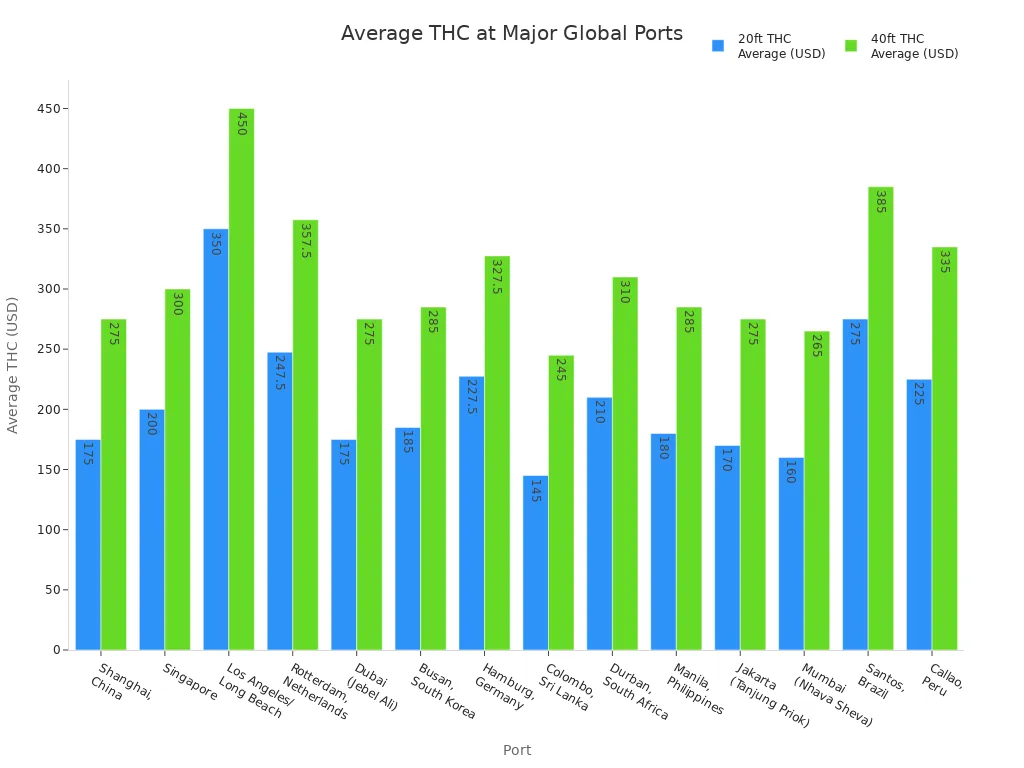
THC rates are different at each port. They also depend on the terminal and cargo type. Here are average THC rates at big ports:
Port | Region | 20ft THC (USD) | 40ft THC (USD) |
|---|---|---|---|
Shanghai, China | Asia | 150–200 | 250–300 |
Singapore | Asia | 180–220 | 270–330 |
Los Angeles/Long Beach, USA | North America | 300–400 | 400–500 |
Rotterdam, Netherlands | Europe | 220–275 | 330–385 |
Dubai (Jebel Ali), UAE | Middle East | 150–200 | 250–300 |
Busan, South Korea | Asia | 160–210 | 260–310 |
Hamburg, Germany | Europe | 200–255 | 300–355 |
Colombo, Sri Lanka | Asia | 120–170 | 220–270 |
Durban, South Africa | Africa | 180–240 | 280–340 |
Manila, Philippines | Asia | 160–200 | 260–310 |
Jakarta (Tanjung Priok), Indonesia | Asia | 150–190 | 250–300 |
Mumbai (Nhava Sheva), India | Asia | 140–180 | 240–290 |
Santos, Brazil | South America | 250–300 | 350–420 |
Callao, Peru | South America | 200–250 | 300–370 |
Documentation Fee
Documentation fees pay for paperwork needed to ship your cargo. You pay this fee to carriers or freight forwarders. They prepare papers like the bill of lading, manifest, and shipping instructions.
Fee Type | Who Charges It | Description |
|---|---|---|
Booking Fee | Freight Forwarder | This fee pays for the forwarder’s paperwork at the start. It is also called Documentation Fee at Origin or House Documentation Fee. If charged at the end, it is called Documentation Fee at Destination or Arrival Agent Fee. |
Always check if documentation fees are charged at both ends.
Container Usage Fee
Container usage fees pay for using and moving containers. These fees change based on the container you use.
Container Type | Cost Implications |
|---|---|
Standard Dry Containers | Lower demurrage and detention fees |
Refrigerated Containers | 30-50% more expensive because they need power and special care |
Open Top Containers | Like standard but may have extra handling fees |
Flat Rack Containers | 20-30% more expensive because they are flexible |
Tank Containers | 50-100% more expensive than standard containers |
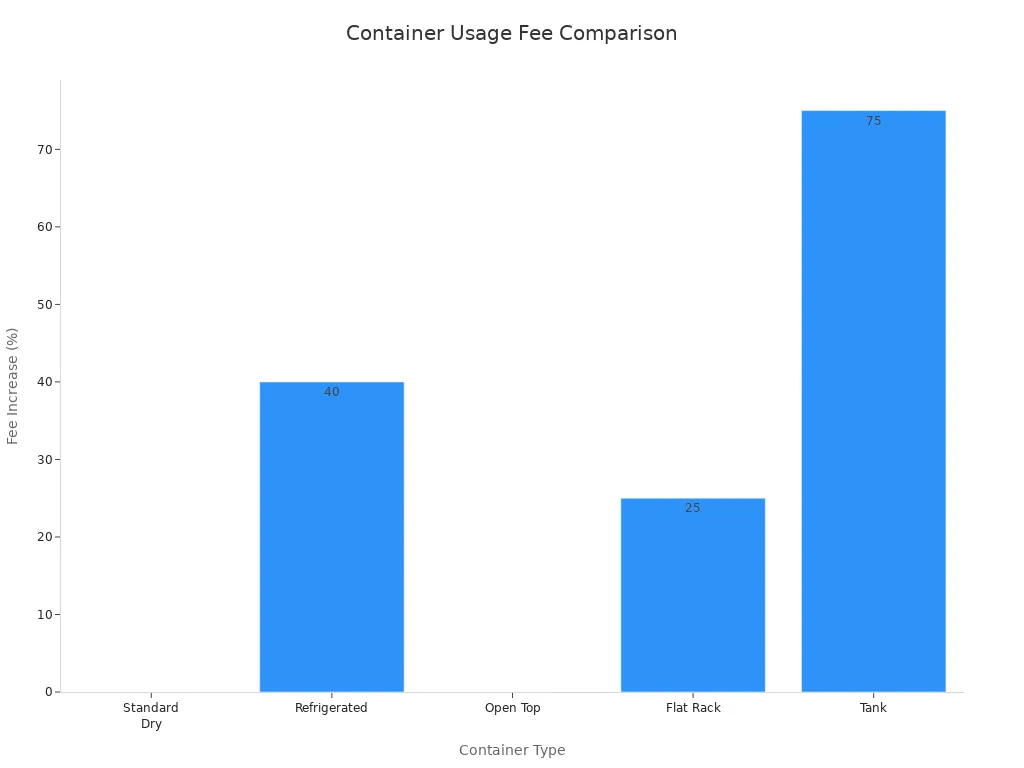
Standard containers are usually the cheapest.
Refrigerated containers cost more because they are special.
Open top and flat rack containers may have extra fees.
Tank containers cost the most because they are very special.
Demurrage and Detention Charges
Demurrage and detention charges happen if you keep containers too long. Demurrage is charged while the container is still at the port. Detention is charged when you keep the container after you pick it up. These fees make you return containers fast.
Port Location | Average DD charges after 14 days for standard containers in USD |
|---|---|
New York | $2,478 |
Oakland | $2,325 |
Los Angeles | $2,069 |
Savannah | $2,014 |
Long Beach | $1,973 |
Houston | $1,919 |
Vancouver | $1,816 |
Hong Kong | $691 |
Chennai | $585 |
Hamburg | $584 |
Tianjin | $140 |
Dalian | $138 |
Yingkou | $135 |
Rizhao | $133 |
Suzhou | $111 |
Colombo | $106 |
Vladivostok | $78 |
Piraeus | $75 |
Jeddah | $43 |
Busan | $40 |
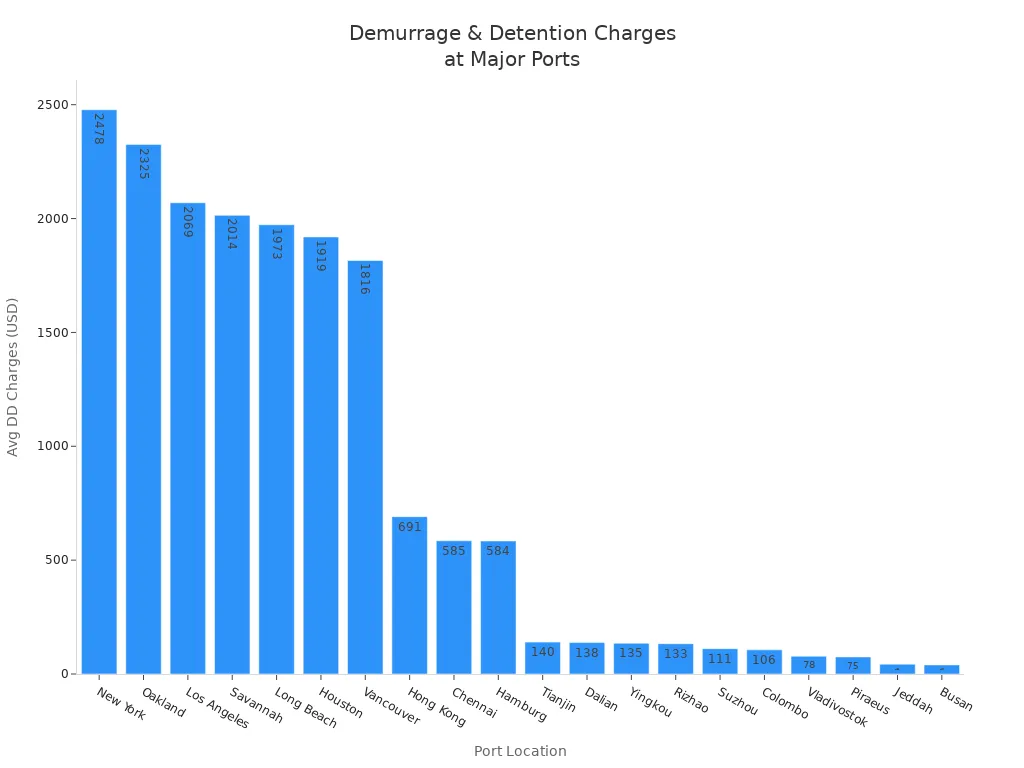
Always check the free time at each port to avoid extra demurrage and detention charges.
Per Diem Fees
Per diem fees are daily charges for keeping containers too long. Some carriers use "per diem" instead of "detention." You pay these fees to make sure you return containers quickly.
Drayage Charges
Drayage charges pay for moving containers between the port and nearby places. These places can be warehouses or rail terminals. You pay drayage when your cargo needs to travel a short way after it arrives or before it leaves. These fees depend on distance, place, and local trucking prices.
CFS Charges (LCL Shipments)
CFS charges are for less-than-container load shipments. These fees pay for services at the container freight station, like:
Trucking the container from the port to CFS
Loading and unloading
Putting shipments together and taking them apart
Palletizing (if needed)
Paperwork handling
Customs release steps
Loading the shipment from the CFS to the truck picking it up
Last-mile delivery (sometimes)
Some CFS charges, like handling fees, are flat. Most are based on the weight or size of your shipment. You can sometimes talk to your logistics provider about these fees.
W/M (Weight or Measurement)
W/M means "weight or measurement." For LCL shipments, you pay based on the higher value. This can be the real weight (in metric tons) or the size (in cubic meters) of your cargo. This way, both heavy and big shipments are priced fairly.
Always check if your bill uses weight or measurement to figure out ocean freight charges.
If you know these ocean freight billing terms, you can control your shipping costs. You can also avoid arguments and plan your budget better for every shipment.
Common Surcharges and Fees
You might see extra fees on your ocean freight bill. These surcharges help carriers pay for special problems that cost more money or slow down shipping. If you know why these fees show up, you can plan for changes in shipping prices and avoid being surprised.
Peak Season Surcharge (PSS)
Carriers add a peak season surcharge when lots of people want to ship at the same time. You pay this fee during busy times when many shipments happen. The surcharge helps carriers pay for higher costs and less space.
Peak season surcharges usually show up:
During holidays at the end of the year
When school starts again
For big sales like Black Friday and Cyber Monday
From June to October for goods from Asia
During special events, elections, or bad weather
You will see higher shipping costs during these times. Carriers might change the surcharge fast if demand changes.
Congestion Surcharge
Sometimes, ports get crowded when too many ships come at once. Carriers add a congestion surcharge to pay for delays and slowdowns. You pay this fee if your cargo waits a long time at busy ports.
Congestion surcharges can include:
Extra charges during busy times
Fees to save a spot at the terminal
Penalties for leaving containers too long
More fees if trucks move slower
Carriers use different ways to set these fees. Some use real extra costs, while others change them based on how busy the port is.
Emergency/War Risk Surcharge
If your cargo goes through dangerous places, you may see an emergency or war risk surcharge. Carriers use this fee to pay for more insurance and safety. You pay this charge if your route has war, pirates, or sudden trouble. The surcharge can go up or down quickly if things get safer or riskier.
Equipment Imbalance Surcharge
Sometimes, ports have too many empty containers and not enough full ones. Carriers must move empty containers to where they are needed, which costs money. The equipment imbalance surcharge pays for this. You often see this fee on busy trade routes, like from China to the US, especially when more goods come in than go out. The surcharge is usually $150 to $500 per container and can make your shipping costs go up fast when there are too many empties.
Accessorial Charges
Accessorial charges pay for extra services not in the normal shipping price. You might see these fees for special help or changes to your shipment.
Detention: When drivers wait too long to load or unload.
Hazmat: For shipping dangerous goods that need special care.
Reconsignment: If you change where your cargo goes after pickup.
Excess Cargo Insurance: For expensive cargo that needs more insurance.
Stop-Off Charges: For extra stops to pick up or drop off cargo.
Tanker Endorsements: For moving large amounts of liquids.
Lumper Fees: For workers who unload cargo for you.
Special Equipment: For using special containers or tools.
Layover Fees: When a driver waits because you are not ready.
Driver Assist Fees: For help unloading cargo.
TONU (Truck Order Not Used): When you cancel a truck after booking it.
Surcharges and accessorial fees can change fast if the market, ports, or events change. Always check your bill and ask your freight forwarder about new or higher charges.
Freight Destination Charges and Payment Terms

Knowing who pays freight destination charges is important. This helps you avoid mistakes and extra costs. You will see different payment terms and Incoterms on quotes. These terms decide who pays for things at the destination. This includes terminal handling, delivery, and other fees.
Prepaid, Collect, and Third-Party Billing
You need to know how payment terms work. This helps you understand who pays which charges. Here is what each billing method means:
In collect freight, you pay when your cargo arrives. The consignee pays for terminal handling and other charges at the destination.
In prepaid freight, you pay before your cargo ships. The shipper pays all charges, including terminal handling at the destination.
In third-party billing, a logistics company pays the charges. This can make things easier for you and your partners.
Check your bill to see which method is used. Each method changes who pays for destination charges. It also affects your cash flow.
Incoterms and Responsibility for Charges
Incoterms are rules that say who pays for what. You must pick the right Incoterm to avoid mistakes. Many people do not understand these terms. This can lead to surprise fees.
Incoterm | Common Misunderstanding | Key Responsibility |
|---|---|---|
FOB | Some think risk moves at the terminal, but it moves at loading onto the vessel | |
CIF | People get confused about insurance coverage | Seller gets insurance in the buyer’s name for at least 110% of value |
DDP | Seller must pay all import costs, which can surprise people | Seller pays all costs and duties for import |
Look at Incoterms before you book your cargo. This helps you avoid paying charges you did not expect.
How Incoterms Affect Freight Destination Charges
Incoterms change who pays for destination charges. The table below shows how each Incoterm changes who pays for terminal handling, delivery, and other fees.
Incoterm | Buyer Responsibility | |
|---|---|---|
EXW | Very little | Almost everything |
FAS | Export clearance | All transport costs and risk |
FCA | Arranging transport | Risk and cost of transport |
FOB | Transport to port | Insurance and transport from port |
CFR | Freight to destination | Delivery from port to final place |
Pick the Incoterm that fits your shipping needs. If you choose wrong, you may pay more or miss fees. Many people mix up demurrage, detention, and terminal handling. Always check your bill. Ask your freight forwarder if you see charges you do not know.
Tip: Look at your ocean freight quote and Incoterms before you ship. This helps you avoid surprise costs and keeps your budget safe.
Reviewing and Managing Ocean Freight Charges
How to Review an Ocean Freight Invoice
You should always check your ocean freight invoice. This helps you avoid paying for mistakes. Mistakes can happen a lot in shipping. If you look at your invoices, you can find errors before you lose money. Here is an easy way to check your invoices:
Gather all your invoices and save them online so you can find them fast.
Sort your invoices by company and date. This makes it easier to compare prices and see patterns.
Set goals for how much you want to spend on shipping. This helps you see if your shipping price is right.
Look for charges that are too high, repeated invoices, or mistakes in how your cargo is listed.
Check the latest prices and make sure you get any discounts.
Watch for extra fees like fuel surcharge, demurrage, or detention.
Study your invoice data to find ways to save money.
Tip: Always compare your invoice to your first freight quote. This helps you spot mistakes in prices, fuel surcharge, or extra fees.
Avoiding Common Billing Mistakes
You can stop many billing mistakes if you know what to look for. Many people pay too much because they do not check their bills. Here are some common mistakes:
Not checking if the freight bill is correct
Missing mistakes in weight or size
Paying the same invoice more than once
Not seeing missing contract discounts
Ignoring extra accessorial charges
Not noticing wrong rates
Forgetting to check demurrage and detention charges
Not matching bills with your contract
Not teaching your team about freight billing
If you watch for these mistakes, you can keep your shipping costs low. You will also avoid surprise fees for demurrage, detention, or fuel surcharge.
Working with Freight Forwarders
Freight forwarders can help you handle and talk about your charges. They know many people in the shipping business and can get better prices for you. They ship a lot, so they can ask for lower rates. They can also help you understand your freight quote and tell you which charges you can change.
When you work with a freight forwarder, you should:
Learn about different shipping rates and choices
Build good relationships with your carriers
Ask your forwarder to explain every charge, like fuel surcharge, demurrage, and detention
Note: A good freight forwarder helps you avoid extra fees and keeps your shipping costs steady.
If you check your invoices, avoid common mistakes, and work with experts, you can control your ocean freight charges. You will also avoid paying too much for demurrage and detention. This keeps your cargo moving and your business strong.
Knowing ocean freight billing terms helps you avoid big mistakes. It also helps you plan your shipping budget better. Some charges, like Peak Season Surcharge and Demurrage, can change fast. You need to pay attention so you do not get surprised.
To protect your business:
Learn about all common charges, like Terminal Handling and Detention.
Check your invoices often to find mistakes.
Plan your shipments before busy times start.
Try to get rate locks so prices do not change suddenly.
Always stay updated and ask experts if you see new or confusing charges. This helps you keep shipping costs low and your business safe.
FAQ
Why do ocean freight invoices include so many different charges?
You see many charges because each fee covers a specific service. Ports, carriers, and forwarders all add their own costs. This helps you understand exactly what you pay for and where your money goes.
Why does the bunker fuel surcharge change so often?
The bunker fuel surcharge changes because fuel prices go up and down quickly. Carriers adjust this fee to cover their real fuel costs. You need to watch this charge since it can affect your total shipping price.
Why should you review your ocean freight invoice every time?
You should review your invoice to catch mistakes, extra fees, or missing discounts. Careful checks help you avoid paying too much. If you find errors, you can fix them before they hurt your budget.
Why do Incoterms matter when paying ocean freight charges?
Incoterms decide who pays for each part of the shipping process. If you pick the wrong term, you might pay unexpected fees. Always check Incoterms before you agree to a shipment.
Why do demurrage and detention fees exist?
Demurrage and detention fees exist to make sure you return containers on time. If you keep containers too long, you pay extra. This helps carriers keep their equipment moving for other customers.
See Also
PGL Offers Comprehensive Ocean Freight Solutions Nationwide
PGL Provides FBA And Bulk Freight Services On The West Coast
Maximize Savings With Premier Global Logistics For FTL Shipping
Effortless Cross-Border Shipping Solutions On The West Coast
Reliable Ocean Shipping Services From Major U.S. Ports By PGL
