How to Start Choosing Freight Providers in Houston Easily

When choosing freight providers in Houston, it's essential to assess your business needs first. Consider the size of your shipments and the frequency with which you send them. Understanding the destinations for your goods is crucial, as some shipments may require special handling, such as temperature control or enhanced security. You will need to determine whether a 3PL company or a direct carrier is the best fit for your requirements. Local providers often have a better understanding of Houston routes and ports, while national companies may offer a more extensive network.
Procurement and supply chain decisions hinge on these key factors:
Key Factor | Description |
|---|---|
Quality and compliance | It's vital to source materials that adhere to industry regulations and standards, ensuring your business operates safely and efficiently. |
Cost management | Striking a balance between price and quality is essential; securing good deals can lead to significant savings for your business. |
Supplier relationships | Building strong partnerships with suppliers can result in better pricing and service. |
With a clear strategy in place, the process of choosing freight providers in Houston can be straightforward and efficient.
Key Takeaways
First, think about what you need to ship. Know how big your shipments are, how often you ship, and where they go. This helps you pick the best freight option.
Check what services each freight company offers. See if they have Full Truckload, Less Than Truckload, or fast shipping choices.
Make sure the company knows the industry and the area. Pick a provider who knows Houston’s roads and your shipping needs.
Check if the provider has the right licenses and insurance. This keeps your business safe and follows the rules.
Ask good questions before you choose a provider. Find out about prices, tracking, and customer help to pick someone you can trust.
Define Your Freight Shipping Needs
Shipment Size and Frequency
First, figure out how big your shipments are. Also, think about how often you send them. This helps you pick the best freight option. Some companies use Full Truckload (FTL) or Less Than Truckload (LTL). FTL is good for big loads that fill a whole truck. LTL works for smaller shipments that do not need a full truck. With LTL, you share space and costs with others. Here is a simple comparison:
Shipment Type | Description | Ideal For | Frequency |
|---|---|---|---|
Full Truckload (FTL) | Whole truck for one shipment | Big, important loads | Not as often, planned when needed |
Less Than Truckload (LTL) | Shares truck with other shipments | Smaller, cheaper shipments | More often, flexible choices |
LTL shipping gives you more choices. You can handle different shipment sizes and times. This helps save money, especially if your shipping changes each month.
Destinations for Shipping to and from Houston
You should look at your main shipping routes. Think about where your goods start and finish. Shipping in houston uses highways, ports, and centers. If you ship to other states or countries, you need a provider with a wide network. Local providers know Houston’s roads and ports well. This can help you avoid delays and keep your supply chain moving.
Special Handling and Industry Requirements
Some shipments need extra care. If you work in energy, manufacturing, or retail, you may need help with hazardous materials or big machines. Many Houston freight providers offer special handling. These services follow strict safety rules. Ask about their experience with your industry’s needs. Special freight services can protect your goods and keep your business safe when shipping in houston.
Evaluate Freight Shipping Companies in Houston

When you look at freight shipping companies in Houston, check what they can do. You should see if they have experience and follow the rules. These things help you pick a company that fits your business. They also help your supply chain work well.
Service Capabilities (FTL, LTL, Expedited, Warehousing)
Start by seeing what shipping services each company has. Many companies in Houston offer different choices. Some options are Full Truckload (FTL), Less Than Truckload (LTL), expedited shipping, and warehousing. A few companies also have drayage and intermodal services. These are useful if you use the port of houston.
Here is a table that shows what top companies offer:
Company Name | Services Offered |
|---|---|
Pronto Shipping & Storage | FTL, LTL, expedited freight, warehousing |
FTL, LTL, expedited freight, warehousing | |
FTL, LTL, expedited freight | |
FTL, LTL, expedited freight, warehousing |
Most top freight shipping companies have all the main services. This means you can change your shipping plans when you need to.
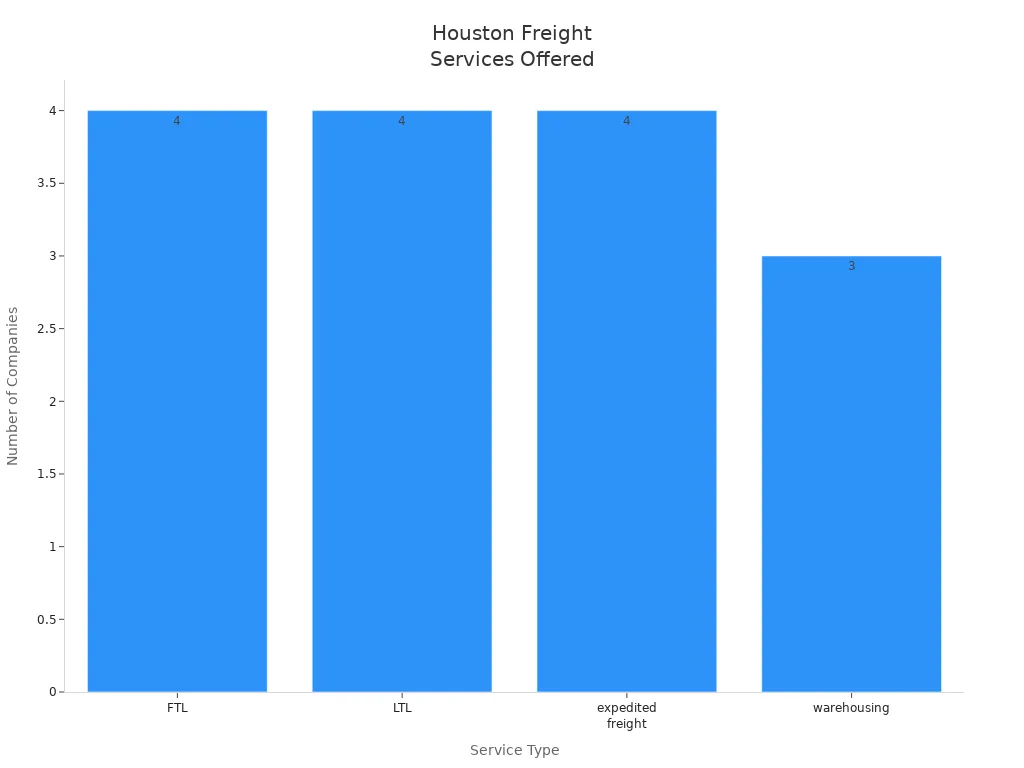
If you want fast shipping, pick a company with good expedited freight. If you need storage, choose one with warehousing near the port of houston or other important places. This helps you keep track of your goods and react fast to changes.
Industry Experience and Local Market Knowledge
You should find out if the company knows your industry. Houston has many types of businesses like energy, oil and gas, manufacturing, and retail. Companies with experience know what your business needs. They know how to move hazardous materials, big machines, or fragile items.
It is also important that the company knows Houston well. The city has busy roads, big ports, and sometimes bad weather like hurricanes. Companies with local knowledge can help you avoid problems and keep your goods safe. They know the best ways to move your shipments and how to handle emergencies.
A manufacturing company in Houston kept working during a hurricane. They stored three weeks of goods at a warehouse in Dallas. The company used a remote team to take orders and answer calls. This plan helped them serve customers without big problems.
You can ask companies about their backup plans. Good companies will have other routes, extra carriers, and ways to store goods. They will also have good ways to talk to you, even if phones or the internet go down.
Licensing, Insurance, and Certifications
You must check that the company has the right licenses and insurance. This keeps your business and your goods safe. Interstate carriers need a USDOT number and at least $5 million in insurance. Carriers that only work in Texas must sign up with the Texas Department of Motor Vehicles (TxDMV) and show proof of insurance.
Here are the main things freight shipping companies in Houston need:
Interstate carriers need a USDOT number and Motor Carrier (MC) authority.
All carriers must show they have liability and cargo insurance.
Intrastate carriers must sign up with TxDMV and fill out Form E (liability) and Forms H & I (cargo).
All carriers must follow USDOT drug-testing rules.
Credential Type | Details |
|---|---|
DOT & MC Authority | Allowed to work across state lines. |
Insurance Coverage (Cargo & Liability) | Insurance to protect your goods and cover accidents. |
Up to $2 million for business protection. | |
Cargo Coverage | Insurance up to $1,000,000 for each load. |
Always ask to see these papers. Good companies will show you their credentials. This step helps you avoid trouble and makes sure your shipments follow the law.
When you compare companies, look for strong services, good experience, and the right paperwork. This helps you build a safe and smooth supply chain in Houston.
Compare Pricing and Technology
Pricing Transparency and Cost Structures
It is important to know how pricing works. Most Houston freight companies use base rates, fuel surcharges, and accessorial charges. Base rates are the main shipping cost. Fuel surcharges change when fuel prices go up or down. Accessorial charges are for extra services like liftgate use or inside delivery. Always ask for a list of all charges before you sign a shipping contract.
There are two main types of rates: contract rates and spot rates. Contract rates stay the same for a set time. Spot rates change with the market. Many businesses use contract rates for regular shipping. Spot rates are used for urgent or extra shipments.
Aspect | Contract Rates | Spot Rates |
|---|---|---|
Pricing | Defined pricing over a set term | Fluctuates based on market conditions |
Stability | Offers stability and predictability | Subject to immediate market fluctuations |
Usage | Often used for core lanes | Used for surges and urgent moves |
Many shippers in Houston have long-term rates. These rates help you plan your budget and avoid surprises.
Technology, Tracking, and Visibility Tools
Modern shipping uses technology to help you. Look for providers with real-time tracking and Transportation Management System (TMS) integration. These tools let you see your shipments as they move. You can check where your shipments are and how long drivers have worked. You can also see the status of each load. This helps you manage your supply chain and react fast to changes.
Here are some common technology platforms used by Houston freight providers:
Technology Platform | Description |
|---|---|
Mothership | Tech-driven shipping with real-time tracking, TMS dashboard, and API integrations. |
C-View | Shipment tracking tool for real-time visibility. |
Real-time tracking and TMS integration show all your shipping data in one place. You can check loads, trucks, and quotes easily. This makes it easier to make choices using current information. Large shippers often need automated updates and self-service portals. These tools help you meet customer needs for fast and reliable shipping. For more details, visit our Houston logistics provider page.
Customer Support and Responsiveness
Good customer support makes shipping easier. Ask about response times before you choose a provider. Some companies use AI to answer questions faster. One freight forwarder improved their response time from 8-12 hours to just 2.6 minutes with AI tools. Fast support helps you fix problems quickly and keeps your shipping on track.
Check if the provider offers support by phone, email, or online chat. Quick answers and clear communication make your shipping experience better. If you want to learn more about customer service in shipping, check out our Houston trucking services resource.
Questions to Ask Before Choosing Freight Providers in Houston
When you start looking for freight providers in houston, you should ask good questions. This helps you find companies you can trust. You want a provider that can move your shipments safely and on time.
What to Include in Quote Requests
A full quote request gives you the right price and service details. You need to share all the important information. This helps freight shipping companies give you the best choices. Use this table to organize your request:
Required Information | Description |
|---|---|
Company Name | Name of your business |
Full Personal Name | Your first and last name |
Your contact email address | |
Phone | Your contact phone number |
Type of Service | Truckload, LTL, Hot Shot, Oversized, etc. |
Pick-up Day | Date for pick-up (MM/DD/YYYY) |
Pick-up Time | Time for pick-up (HH:MM AM/PM) |
Drop-off Day | Date for drop-off (MM/DD/YYYY) |
Drop-off Time | Time for drop-off (HH:MM AM/PM) |
Pick-up Location Zipcode | Zip code for pick-up location |
Drop-off Location Zipcode | Zip code for drop-off location |
Weight in Pounds | Total shipment weight |
Dimensions (LxWxH) | Shipment size |
Comments | Special instructions or notes |
You should fill out every part of the form. This helps the provider know what you need. Then they can offer the right shipping services.
Key Questions on Insurance, Tracking, and Delivery
You want to trust your freight shipping company. Ask these questions before you choose:
How do you make sure shipments are on time?
What do you do if something goes wrong?
What is your on-time delivery rate?
How do you check carrier compliance?
How do you handle damage claims or rules problems?
These questions show if the provider cares about safety and good service. You can compare answers from different companies. This helps you pick the best one for your business.
Tip: Good providers will answer your questions clearly and show their records. This helps you trust them and avoid problems later.
References and Customer Reviews
You should always check references and reviews before you pick a provider in houston. This step shows how companies work in real life. Use this table to help you review them:
Aspect | Details |
|---|---|
Strong Reputation | Look for customer references and online reviews to check reliability and service quality. |
If you cannot find reviews online, ask the provider for references. Many businesses share feedback about their shipping services. Reading reviews helps you see common problems and good points. You want a provider with a strong reputation and happy customers.
By asking these questions and checking reviews, you make choosing freight providers in houston much easier. You keep your business safe and build a strong supply chain.
Final Checklist for Selecting Freight Shipping Companies
Assessing Proposals and Red Flags
You need a simple way to compare offers from freight providers in Houston. Start by checking what matters most for your business. Use the table below to help you look at each offer:
Description | |
|---|---|
Price | The cost of the offer is important when picking a provider. |
Vendor Reputation | Look at the vendor’s history and if they are reliable. |
Safety | Check the vendor’s safety records and how they keep things safe. |
Quality | See if the goods or services in the offer are good quality. |
Benefit to Port Houston | Think about how the offer helps Port Houston overall. |
Participation of Diverse Businesses | Make sure small, minority, and woman-owned businesses are included in the offer. |
Look for hidden fees or unclear rules in each offer. If a provider cannot explain their prices or avoids talking about insurance, this is a warning sign. Watch out for unclear answers about logistics, transportation, or technology. Good companies in Houston will always give clear details and show proof they follow the rules.
Tip: Ask for recent customer references. If a provider does not want to share or only gives old contacts, this is another warning sign.
Making the Final Decision
Follow these steps to pick your provider and build a strong partnership:
Check the provider’s experience. Pick a company that has done logistics and drayage before.
Make sure they have enough trucks. The vehicles should be in good shape for your freight.
Confirm they follow all rules. Check local, state, and federal requirements for transportation.
Look for clear prices. Choose providers who tell you all costs upfront.
Check how they talk to you. Pick a company with fast support and real-time tracking.
See if they use modern tools. Choose a provider that uses new logistics technology for tracking and paperwork.
You can use this checklist to compare providers side by side. This helps you avoid mistakes and keeps your logistics running well in Houston. If you still have questions or want expert help, ask for a freight consultation or a detailed quote. This step gives you more confidence before you make your final choice.
You can find the best freight provider in Houston if you follow some easy steps. First, collect all the details about your shipment. Next, pick if you need truckload or less-than-truckload shipping. Then, look at quotes from different companies. Use a checklist and ask about their experience, technology, and prices. Try to choose partners who have shown they are good at shipping. If you want more help, ask for a meeting or a full quote. This can help your business get bigger.
FAQ
What documents do you need to ship freight in Houston?
You need a bill of lading, proof of insurance, and shipment details. Some shipments require special permits. Always ask your provider for a checklist before you ship.
How do you check if a freight provider is licensed?
Ask for their USDOT and MC numbers. You can verify these on the FMCSA website. Licensed providers follow safety and insurance rules.
What is the difference between FTL and LTL shipping?
FTL means your goods fill a whole truck. LTL means you share space with other shipments. Choose FTL for large loads. Use LTL for smaller shipments.
How do you track your shipment?
Most providers offer online tracking tools. You can log in to see real-time updates. Some companies send alerts by email or text.
What should you do if your shipment is delayed?
Contact your provider right away. Ask for an update and a new delivery estimate. Good providers will explain the cause and help you plan your next steps.
See Also
Selecting LTL, FTL, Or Drayage Solutions For Trucking
PGL Enhances West Coast Freight With Flexible Trucking Solutions
Reliable Trucking Services Offered By PGL In Major Cities
Streamlined Freight Shipping Solutions Across The Southeast Region
