Everything You Need to Know About Customs Broker Qualifications in the US
What does it take to become a customs broker in the US? You need to meet several customs broker qualifications. Here is what you must have:
U.S. citizenship
Minimum age of 18 years
Good moral character
No federal employment restrictions
Passing score on the Customs Broker License Exam
Completed application and background check
These steps help you start your journey in international trade.
Key Takeaways
To become a customs broker, you must be a U.S. citizen and at least 21 years old.
Passing the Customs Broker License Exam is essential; prepare well to increase your chances of success.
Submit a complete application with all required documents to avoid delays in receiving your license.
Good moral character is crucial; be honest on your application and prepare for a background check.
Stay organized and keep learning to build a successful career in customs brokerage.
Customs Broker Qualifications Overview
Main Requirements List
You need to meet several customs broker qualifications before you can work in this field. The United States Customs and Border Protection (CBP) sets clear rules for everyone who wants to become a customs broker. Here is a simple list of what you must do:
You must be a United States citizen.
You must be at least 21 years old.
You cannot work for the Federal Government at the time you apply.
You must show good moral character.
You must pass the Customs Broker License Examination.
You must submit a broker license application and pay the required fees.
CBP must approve your application after a review.
Tip: You should check each requirement carefully before you start the process. Meeting all customs broker qualifications helps you avoid delays and problems later.
Eligibility Criteria
You must meet every item on the list above to qualify for a customs broker license. Citizenship is the first step. Only United States citizens can apply. Age matters too. You need to be at least 21 years old, even though some sources mention 18 as a minimum for other trade jobs. Federal employees cannot apply, so you must not work for the government when you submit your application.
Good moral character means you follow the law and act honestly. CBP looks at your background to make sure you meet this standard. Passing the Customs Broker License Examination shows you understand customs laws and procedures. After you pass the exam, you must complete the application and pay the fees. CBP reviews your application and checks your background before giving you a license.
You should remember that customs broker qualifications are strict for a reason. The government wants to make sure only trustworthy and knowledgeable people help businesses with international trade. If you meet every requirement, you can move forward with confidence.
Customs Broker Role
Key Responsibilities
As a customs broker, you play a vital part in the import and export process. Your job helps businesses move goods across borders smoothly. You handle many important tasks every day:
Prepare and submit all required documents to customs, such as import/export declarations, invoices, and packing lists.
Determine the correct tariff classification for goods. This step affects how much duty and tax your client must pay.
Facilitate customs clearance. You make sure shipments follow all rules and get released on time.
Handle the payment of duties and taxes for your clients. You ensure all financial obligations are met.
Advise clients on compliance with trade regulations. Your guidance helps businesses avoid costly mistakes.
Act as a link between businesses and customs authorities. You answer questions and solve problems that may come up.
Review paperwork to make sure everything is correct. You help prevent delays by keeping documents in order.
Note: Your attention to detail and knowledge of regulations help keep the supply chain moving.
Importance in Trade
You help keep international trade running smoothly. Your work ensures that goods enter and leave the country without problems. When you prepare documents and classify goods correctly, you help your clients follow the law. You also help them avoid fines and delays.
Customs brokers play a big role in the economy. You help companies adjust to new rules, tariffs, and costs. Your work supports clear communication between businesses and customs officials. This teamwork helps everyone plan better and avoid surprises.
Here is how your role impacts different areas of trade:
Impact Area | Description |
|---|---|
You update product details and use new document formats to meet stricter rules. | |
Impact on Clearance Times | You plan ahead to handle less predictable clearance times caused by more inspections. |
Adjustments in Costs | You help clients manage changes in tariffs that affect the price of imported goods. |
Supply Chain Adjustments | You guide companies in changing suppliers or routes to lower costs. |
Increased Focus on Compliance | You pay close attention to new rules to help clients avoid fines and delays. |
Enhanced Communication | You keep clients informed so they can respond quickly to changes in trade regulations. |
Your expertise makes you a key partner in global trade. You help businesses succeed in a complex world.
Detailed Requirements Breakdown
Citizenship and Age
You must meet specific citizenship and age requirements before you can apply for a customs broker license. The United States Customs and Border Protection (CBP) checks these details carefully. You need to show proof of your U.S. citizenship and confirm your age. You must be at least 21 years old before you take the exam. The table below shows the main requirements:
Requirement | Details |
|---|---|
U.S. Citizenship | |
Age Requirement | Must be 21 prior to examination |
Employment Status | Cannot be a U.S. Government employee |
You should have your documents ready when you apply. This step helps you avoid delays in the process.
Employment Restrictions
CBP wants to make sure only qualified people work as customs brokers. You cannot work for the federal government when you apply. You also must not work with or for people who lost their broker license or have a bad reputation. The table below explains the main employment restrictions:
Restriction Type | Description |
|---|---|
Employment from disreputable individuals | You cannot accept jobs from people whose broker license was revoked or who are disreputable. |
Assistance in customs transactions | You cannot help disreputable individuals with customs transactions. |
Employment approval | You must get approval before working with disreputable individuals. |
Fee sharing | You cannot share fees with disreputable individuals. |
Business control | Disreputable individuals cannot control or direct your business. |
You must follow these rules to keep your license and protect your reputation.
Good Moral Character
CBP checks your background to make sure you have good moral character. You will go through a background investigation. This process includes fingerprint analysis, checking character references, reviewing credit reports, and looking at arrest records.
Each Broker license applicant must undergo a background investigation that includes a fingerprint analysis and review of character references, credit reports, and arrest records. Arrests and convictions do not necessarily preclude the issuance of a license.
You should always be honest on your application. If you have questions about your record, you can ask CBP for guidance. Meeting all customs broker qualifications shows you are ready for this important job.
Customs Broker Exam

Exam Format
You will take the Customs Broker License Exam in an open-book setting. The test has 80 multiple-choice questions. You get 4.5 hours to finish. You can use reference materials, but you must manage your time well. The exam takes place twice a year, in April and October.
Detail | Information |
|---|---|
Exam Fee | |
Time Limit | 4.5 hours |
Format | 80 multiple-choice questions, open book |
Offered | Twice per year (April & October) |
Passing Score | 75% |
Pass Rate | Historically under 20% |
Topics Covered
The exam covers many areas that test your customs broker qualifications. You need to know about laws, procedures, and real-life situations. Here are the main topics you will see:
Entry and Entry Summary
Classification of goods
Trade Agreements
Valuation and Duty Assessment
Broker Compliance
Power of Attorney
Marking and Country of Origin
Drawback (refunds of duties)
Bonds
Foreign Trade Zones
Warehouses
Fines and Penalties
Intellectual Property Rights
Tip: Review each topic carefully. The exam will test both your knowledge and your ability to apply it.
Fees and Schedule
You must pay a $390 fee to take the exam. If you pass, you will pay more fees for your license and background check. The exam happens every April and October.
Fee Type | Amount |
|---|---|
Examination Fee | $390 |
Individual License Application Fee | $300 |
Partnership License Application Fee | $500 |
Fingerprinting Processing Fee | Varies |
National Permit Application Fee | $100 |
Annual National Permit User Fee | $180.57 |
Triennial Status Report Fee | $100 |
Pass Rates and Prep Tips
The pass rate for this exam is low. Many people do not pass on their first try. For example, in April 2023, only 5.5% passed. In October 2023, the pass rate was 34%. You need to prepare well.

Here are some tips to help you succeed:
Limit distractions and clear your schedule before the exam.
Take several timed practice tests to improve your speed.
Learn the exam format to feel more confident.
Pack all needed materials the night before.
Get enough sleep and arrive early.
Manage your time during the test.
Read each question carefully.
Answer every question, even if you must guess.
Focus on passing, not perfection.
Remember: Good preparation is key to meeting customs broker qualifications and passing the exam.
Application and Licensing Process
Submitting Your Application
You need to gather several documents before you submit your customs broker license application. The process starts after you pass the exam. You must fill out CBP Form 3124, which is the official application for a Customs Broker License or Permit. You also need to pay the application fee. If you plan to use a trade or fictitious name, you must show proof of your authority to use it. You should include one copy of the required attachment, such as Articles of Agreement, an affidavit signed by partners, or Articles of Incorporation. If you passed the exam, you must provide notification of your results. During your interview, you will give your fingerprints.
Checklist for your application:
CBP Form 3124
Application fee
Notification of passing the exam
Articles of Agreement, affidavit, or Articles of Incorporation
Proof of authority for trade or fictitious name (if needed)
Fingerprints at the interview
Tip: Double-check your documents before you submit your application. Missing paperwork can delay your license.
Federal Background Check
You must complete a federal background check after you submit your application. This step helps CBP confirm your good moral character. You will fill out a Security Questionnaire, such as SF-85, SF-85P, or SF-86. You must submit your fingerprints and other documents to verify your identity. The Defense Counterintelligence and Security Agency (DCSA) or another agency will investigate your background. The review includes fingerprint analysis, checking character references, looking at credit reports, and reviewing arrest records.
Steps in the background check:
Complete the Security Questionnaire.
Submit fingerprints and identity documents.
Undergo a background investigation by DCSA or another agency.
Note: Arrests or convictions do not always prevent you from getting a license. Honesty on your application is important.
Licensing Timeline
You should expect the licensing process to take several months. After you pass the exam, you submit your application and start the background check. Most applicants receive their license within six months. Preparation and careful attention to each step help you avoid delays.
Step | Estimated Timeframe |
|---|---|
Pass the exam | Varies |
Submit application | Immediately after exam |
Complete background check | 2–6 months |
Receive license | Up to 6 months total |
Keep track of your progress. If you prepare well, you can move through the process smoothly.
Tips for Success
Study Strategies
You can boost your chances of passing the customs broker exam with the right study plan. Many candidates find these steps helpful:
Take at least five to ten timed practice tests. This helps you manage your time and get used to the exam format.
Index your tariff book and the 19 CFR. This makes it easier to find answers quickly.
Study with a partner instead of a large group. A study buddy keeps you accountable.
Set your exam date based on your own readiness, not outside pressure.
Create clear study goals and track your progress with milestones.
Tip: Avoid cramming. Spread your study sessions over several weeks for better results.
You can also use special courses and resources to prepare. Here are some options:
Resource Name | Features | Duration | Access |
|---|---|---|---|
Customs Broker Exam Prep Course | Expert instructors, comprehensive materials, practice tests, personalized support | 16 weeks | 24/7 access |
The Customs Broker Exam Prep Course | High-quality test prep materials, personal instructor | N/A | N/A |
Everything You Need to Get Ready for the Customs Broker Exam | Comprehensive courses, live instructors, high pass rate | N/A | 24/7 access |
Career Advice
After you meet all customs broker qualifications, you can explore many career paths. You might work for a brokerage firm, a freight forwarding company, or a large corporation involved in global trade. Some brokers move up to roles like Compliance Manager or International Trade Consultant. Others choose to start their own brokerage business.
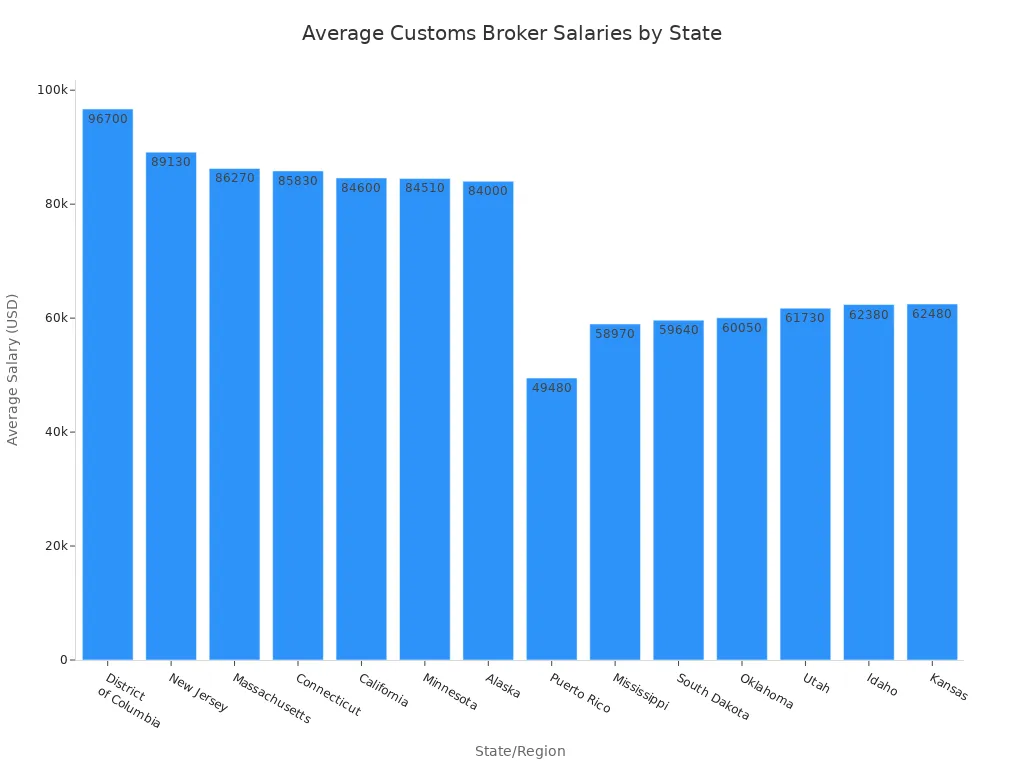
Many companies, such as Costco, Target, and Walmart, hire customs brokers. You can also work for multinational corporations or logistics companies. Salaries vary by state. For example, in the District of Columbia, the average salary is $96,700. In California, it is $84,600.
New customs brokers often face challenges. You may need to handle complex regulations, manage lots of paperwork, and keep up with changing trade policies. Good communication and attention to detail help you succeed. Joining groups like the National Customs Brokers & Forwarders Association of America gives you access to education and support.
Remember: Stay organized, keep learning, and connect with others in the field to build a strong career.
You can become a customs broker by following these steps:
Meet eligibility requirements, including citizenship and age.
Pass the Customs Broker License Exam.
Submit your application and fingerprints.
Attend an interview.
Complete a background check.
Receive your license by mail.
With steady preparation, you can succeed. Many people study for four months and work with a study buddy. If you want to learn more, explore resources like the CBP Continuing Education Webpage and Federal Register: Continuing Education for Licensed Customs Brokers. Start your journey today!
FAQ
What is the passing score for the Customs Broker License Exam?
You need a score of at least 75% to pass the exam. The test has 80 multiple-choice questions. You must answer at least 60 questions correctly.
Can you retake the Customs Broker License Exam if you fail?
Yes, you can take the exam again. The exam happens twice a year, in April and October. You must pay the exam fee each time you try.
Do you need a college degree to become a customs broker?
No, you do not need a college degree. You must meet the age, citizenship, and moral character requirements. You also need to pass the exam and complete the application process.
How long does it take to get a customs broker license?
The process usually takes up to six months after you pass the exam. This time includes submitting your application and completing the background check.
Can you work as a customs broker if you have a criminal record?
CBP reviews each case. Arrests or convictions do not always stop you from getting a license. You should be honest on your application and provide all required information.
See Also
Comprehensive Ocean Export Services for U.S. FCL and LCL Shipments
Key Steps for LCL Shipping to Panama by Premier Global Logistics
Streamlined FCL Export Solutions Across the United States
Navigating the LCL Export Process to Panama with Premier Global Logistics
Simplifying Cross-Border Freight from the West Coast with Premier Global Logistics
