What Is the Freight Loss Recovery Process and Why It Matters for Your Business
The freight loss recovery process helps you manage the gap between your actual shipping costs and the quoted freight rates. Many companies face freight loss often. In fact, 1 in every 51 shipments results in a damage or loss claim, with the average claim costing $3,777 per LTL shipment. When you handle claims quickly and clearly, you protect your profit margins and keep your customers satisfied. Paying attention to these losses can improve your cash flow and support your business's long-term success.
Key Takeaways
Freight loss can significantly impact your business, costing an average of $3,777 per shipment. Understanding this helps you prioritize recovery processes.
Act quickly when you notice freight loss. Timely claims improve your chances of recovering losses and maintaining cash flow.
Keep thorough documentation, including shipping records and photos of damage. Strong records support your claims and speed up the recovery process.
Utilize digital tools for claims management. These tools streamline the process, reduce paperwork, and provide real-time updates on claim status.
Regular audits of your shipping processes can uncover billing errors and improve your overall freight management strategy.
Freight Loss Recovery Process Overview
What Is Freight Loss?
Freight loss happens when goods do not reach their destination as planned. You might see this as missing items, damaged products, or shipments that never arrive. Every year, cargo losses cost businesses more than $50 billion worldwide. These losses can come from many sources, such as theft, misrouting, or mistakes during shipping. For example, cargo theft alone costs trucking companies and retailers between $15 billion and $30 billion each year. When you understand what freight loss means, you can see why it is important to have a strong freight loss recovery process in place.
Key Elements of the Freight Loss Recovery Process
You need a clear plan to handle freight loss. The freight loss recovery process helps you respond quickly and recover your money or goods. Here are the main stages you should know:
Stage | Description |
|---|---|
Timeliness in the Freight Claims Process | Report losses quickly and provide proof of delivery to start the claims process. |
Documentation Standards for Freight Claims | Keep original invoices, shipping documents, and photos of any damage. |
Monitor and Update Claim Status | Stay informed by checking claim updates and keeping communication open with all parties. |
Freight Damage Types | Identify both visible and hidden damage to improve your chances of a successful claim. |
Navigating Complex Freight Claims | Use expert knowledge to handle complicated claims. |
Leverage Technology for Enhanced Cargo Claims Efficiency | Use digital tools and automated systems to speed up the process. |
A systematic freight loss recovery process brings many benefits. You can protect your customer relationships, improve how you handle returns, and save money on labor and inventory. For example, better return management can help you keep more customers and save thousands of dollars each year. You also get more accurate inventory records and recover more costs from warranties.
Tip: Always keep your shipping documents and photos of your goods. This makes it easier to file a claim if something goes wrong.
Types of Freight Loss Incidents
Freight loss can happen in many ways. Some of the most common causes include improper packaging, unclear labeling, poor loading, environmental factors, and handling errors. Here is a table that shows the main causes:
Cause | Description |
|---|---|
Improper Packaging | Using the wrong materials can cause damage during shipping. |
Inadequate Labeling | Labels that are unclear or incorrect can lead to lost or misrouted shipments. |
Poor Loading Practices | Goods loaded incorrectly can get damaged in transit. |
Environmental Factors | Extreme temperatures or humidity can harm goods if not packed well. |
Handling Errors | Rough handling during loading, unloading, or transit can damage shipments, especially LTL shipments. |
You may also face different types of incidents, such as:
Loss: The cargo never arrives or goes missing.
Shortage: Fewer items arrive than expected.
General Damage: You see damage when the goods arrive.
Concealed Damage: You find damage after delivery.
Losses can also come from bad stowage, poor containers, wrong carriage instructions, bad sealing, rough seas, and even piracy. The chart below shows the percentage of different freight loss incidents in international shipping:
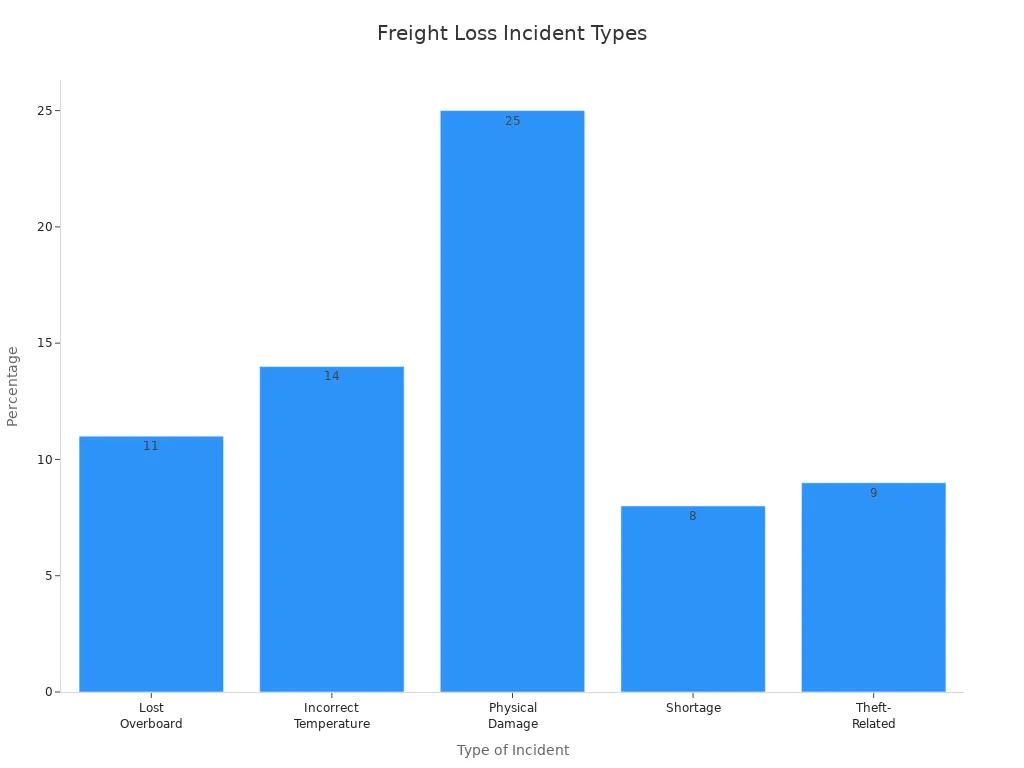
When you know the types and causes of freight loss, you can take steps to prevent them. A strong freight loss recovery process helps you act fast, recover your losses, and keep your business running smoothly.
Business Impact of Freight Loss
Financial Risks and Cash Flow
Freight loss can create serious financial problems for your business. When you lose goods, you may face cash flow gaps. These gaps make it hard to pay your bills on time or invest in new opportunities. You might need to use special cash management strategies to keep your business running. Many companies use automated systems to improve invoice accuracy and speed. This helps reduce cash flow issues. You can also use freight finance solutions, such as invoice factoring or supply chain finance, to maintain liquidity. These tools help you manage your money better when you face unexpected losses. A strong freight loss recovery process can protect your cash flow and keep your business stable.
Operational Challenges
Freight loss does not just affect your finances. It also creates many challenges in your daily operations. You may deal with inefficient cargo handling, which can damage fragile items like glassware. Sometimes, poor storage can spoil important goods, such as vaccines. Damaged shipments can disrupt your supply chain. This leads to missed deadlines and unhappy customers. You might need to spend extra time and resources to fix these problems. When you face frequent freight loss, your team may feel stressed and less productive.
Reputational Effects
Freight loss can hurt your reputation with clients and partners. Missed shipments and service disruptions make your business look unreliable. Customers may lose trust and choose other companies. You could lose contracts and get fewer referrals. Financial problems, such as chargebacks and higher insurance premiums, may follow. Inconsistent service forces you to spend more time fixing mistakes. Small businesses may struggle even more, facing long-term setbacks. Missed pickups and late deliveries frustrate your customers. Poor communication can damage your brand. You may lose revenue and pay more to solve these issues. Taking steps to improve your freight loss recovery process helps protect your reputation and keeps your customers happy.
Freight Loss Recovery Steps
Claim Initiation and Filing
You need to act quickly when you notice freight loss or damage. The first step in the freight loss recovery process is to start your claim as soon as possible. Fast action helps you meet carrier deadlines and improves your chances of success. You should follow these steps to begin:
Identify the shipment that suffered loss or damage.
List the type of loss, such as shortage, damage, or missing items.
Determine the value of your claim based on the invoice and cost of goods.
Make a demand for payment from the carrier.
You can send your claim using several methods. Many businesses use fax, certified mail, express courier services, or electronic data exchange. Choose the method that fits your needs and keeps a record of your communication.
Tip: Start your claim as soon as you spot a problem. Quick action helps you recover your losses and keeps your business running smoothly.
Documentation and Evidence
Strong documentation supports your claim and speeds up the freight loss recovery process. You need to gather and organize all the required paperwork. Carriers often ask for specific documents to prove your case. Here is a list of what you should collect:
Original bill of lading: This shows the details of your shipment.
Paid freight bill: Proof that you paid for shipping, even if the goods are damaged.
Inspection reports: These document the condition of your goods when they arrive.
Proof of commodity value: Invoices show the value of lost or damaged items.
Notification of loss: Written notice to the carrier about the problem.
Photographs: Pictures of the damage or missing items.
Police reports: Needed if theft or criminal activity caused the loss.
Weight certificates: These help verify shortages or discrepancies.
Timely documentation makes your claim stronger. When you submit paperwork quickly, you meet carrier requirements and help resolve claims faster. This efficiency helps you recover lost funds and keeps your customers satisfied.
Note: Keep all your shipping documents and photos in a safe place. Good records make it easier to file claims and prove your losses.
Evaluation and Resolution
After you file your claim and submit your documents, the carrier reviews your case. You need to follow several steps to reach a resolution:
Inspect the shipment right away for any damage or missing items.
Compile all relevant documents, such as the bill of lading and photos of the goods.
Follow up regularly with the carrier to keep your claim moving.
Negotiate for a settlement that covers your loss.
Seek legal advice if you cannot reach an agreement.
Carriers look at commercial invoices, proof of product value, packing lists, and photos taken at loading. You should know your carrier’s liability structure and understand how they handle claims for lost, damaged, or short freight. Regular follow-up and clear communication help you resolve claims faster.
Alert: Always check your shipment as soon as it arrives. Early inspection helps you spot problems and start your claim before deadlines pass.
A strong freight loss recovery process helps you manage claims efficiently. You protect your business, recover your losses, and keep your customers happy.
Best Practices for Claims Management
Timely Response
You need to act fast when you spot freight damage or loss. Quick action helps you meet carrier deadlines and improves your chance of a successful claim. Here are steps you should follow for a timely response:
Inspect the shipment for any signs of damage as soon as it arrives.
Take clear photos of the damage from different angles.
Write down any damages or shortages on the delivery receipt.
Get witness statements if anyone saw the damage happen.
Notify the carrier in writing and attach your photos.
Keep the damaged goods safe until the claim is resolved.
Tip: Do not delay reporting damage. Waiting can lead to claim denials or longer wait times for compensation.
Accurate Record-Keeping
Good records make your claims stronger and faster. You should keep all documents from pickup to delivery. This includes inspection reports, delivery confirmations, and photos of damaged cargo. Accurate records help you avoid disputes and show exactly what happened. They also prevent delays and denials during the claims process.
Document every step to create a clear story of your shipment.
Build strong packaging records to counter common denial reasons.
Respond quickly with complete information to speed up resolutions.
Note: Missing or incomplete paperwork can make it hard to prove your case.
Expert Support and Audits
Sometimes, you need help from experts or third-party auditors. These professionals check your invoices and spot errors. They also review your freight management strategies and help you find better rates. Auditors can show you which carriers perform poorly and help you manage costs.
Expert support helps you resolve disputes and get timely payments.
Audits give you insights to improve your shipping process.
Advisors can help you reset expectations with carriers or seek reimbursement when problems keep happening.
Alert: Ongoing issues may signal a need for a freight audit advisor to review your process.
By following these best practices, you can handle claims more efficiently and protect your business from unnecessary losses.
Technology and Professional Solutions
Digital Claims Management Tools
You can use digital claims management tools to make your freight claims process faster and more accurate. These tools help you organize your documents, track claims, and communicate with carriers. Many companies now use platforms like FileHandler, Guidewire ClaimCenter, Origami Risk, and Snapsheet Claims Platform. Each tool offers unique features to help you manage claims from start to finish.
Here are some key features you will find in modern claims management tools:
Feature | Description |
|---|---|
Full-service loss and damage claims management | Lets you file more claims and recover more money across all shipping types. |
Detailed reporting | Gives you insights by carrier, cause, product, and location to help reduce future losses. |
Centralized process | Keeps your claims process consistent and lowers your administrative costs. |
When you use these tools, you can:
Automate claim filing and tracking, which saves you time.
Centralize your data for better coordination and easier document management.
Get real-time updates, so you always know the status of your claims.
Reduce paperwork and focus on solving problems quickly.
Tip: Digital tools help you submit claims faster and improve your recovery results. They also make it easier to spot patterns in your claims data.
Freight Recovery Audits
Freight recovery audits help you find mistakes in your shipping bills and contracts. You can use these audits to recover overpayments and improve your shipping process. The audit process includes collecting shipment data, checking invoices, and working with carriers to get refunds.
Process Steps | Benefits |
|---|---|
Data collection from shipment history | Cost Savings: Recovering overpayments helps your bottom line. |
Analysis of invoices and contracts | Improved Contract Negotiations: Get better rates with new insights. |
Identification of billing errors | Regulatory Compliance: Stay within the rules. |
Collaboration with carriers for refunds | Data-Driven Decision Making: Make smarter choices for your business. |
Process Improvement: Find ways to save money. | |
Carrier Performance Monitoring: See which carriers do the best job. |
Many businesses see strong results from audits. For example, some carriers like UPS and FedEx resolve 60-70% of loss and damage claims. When you use technology and audits together, you protect your profit margins, keep customers happy, and make better decisions for your business.
You protect your business when you build a strong freight loss recovery process. Over time, you see many benefits:
You reduce financial losses with quick claims and clear records.
You lower your team’s workload and speed up claim results.
You cut risks and gain expert support for complex cases.
You improve profit margins by finding and fixing claim process gaps.
Adopt best practices and use digital tools to keep your business stable for the future.
FAQ
What documents do you need for a freight loss claim?
You need the bill of lading, paid freight bill, inspection report, and photos of the damage. You should also include invoices and any written notice to the carrier.
How long do you have to file a freight claim?
Most carriers give you 9 months to file a claim. You should check your carrier’s policy. Filing as soon as you notice a problem helps your case.
Who pays for lost or damaged freight?
The carrier usually pays if you prove the loss or damage happened during shipping. You must show proof with documents and photos.
Can you prevent freight loss?
You can lower your risk by using strong packaging, clear labels, and careful loading. You should also train your team and use digital tools to track shipments.
See Also
Maximize Savings with Premier Global Logistics’ FTL Shipping
Begin Your Freight Journey with PGL's FTL Services
PGL Delivers Expert Solutions for LTL and FTL Shipping
Streamlined West Coast Trucking Solutions by PGL for Supply Chains
