Why Freight RFP Best Practices Save You Money Fast

Freight RFP best practices help you save money quickly. If you work on making transportation buying better, you will see real savings soon. You can use data, technology, and a clear request for proposal process. This helps you get savings faster than you think.
Many companies see results from freight changes in 3 to 6 months. This happens more when they use analytics and AI.
Think about how your freight process works now. Small changes can make you save a lot.
Key Takeaways
Set clear rules to compare carriers in a fair way. This helps you pick the best carrier for your needs. It also helps you save money.
Look at past performance data to avoid paying too much. Use old numbers to find carriers that cost less. This helps you make better shipping plans.
Use technology and data to make smarter choices. Tools can track shipments and compare prices. They can also guess market changes. This can help you save a lot of money.
Make picking carriers easier by matching needs and budget. This lowers risks and builds strong partnerships. You can trust reliable carriers more.
Help teams and vendors work together. Working as a team solves problems faster. It can also lower freight costs by 10-18%.
Freight RFP Best Practices for Cost Savings
You can save money quickly when you use freight RFP best practices. These steps help you make smart choices and avoid mistakes. You also get more value from your freight procurement. Let’s see the best ways to run a good RFP and lower costs.
Define Clear Evaluation Criteria
You should set clear rules before starting your RFP. When you know what is important, you can compare carriers in a fair way. This helps you pick the best one for your needs. Clear evaluation criteria help you focus on what saves money and gives good service.
Here is a table that shows the most important evaluation criteria:
Evaluation Criteria | Description |
|---|---|
Set KPIs | Identify measurable metrics like on-time delivery rates and tracking accuracy. |
Specify required services | Define logistics needs to help carriers understand expectations. |
Mandatory requirements | Outline non-negotiable qualifications such as certifications and safety protocols. |
Terms and conditions | Define contractual expectations including payment terms and penalties. |
Evaluation criteria | Detail factors like experience, reliability, and cost for selection. |
Tip: When you set clear rules, it is easier to compare offers and find the best value.
Clear evaluation criteria do more than just organize your process. They help you match your goals with your sourcing plan. You can look at service levels, prices, and reliability. This setup lets you find carriers who do more than you expect. You save time and avoid confusion. This leads to better results in procurement.
Clear evaluation criteria match your goals and help you decide.
You can check service, price, and reliability to save money.
A good plan helps you build long-term partnerships with the right carriers.
Use Historical Performance Analysis
Looking at old data helps you make better choices in freight procurement. You can see which carriers did well and which ones cost more. This step helps you not make the same mistakes and find new ways to save.
Here are key metrics to check:
Metric | Description |
|---|---|
Volume Metrics | Track the total amount of freight handled, providing insights into capacity and demand. |
Revenue Metrics | Analyze financial performance related to freight, indicating profitability and cost-effectiveness. |
Response Times | Measure how quickly proposals are submitted, reflecting operational efficiency. |
Win Rates | Evaluate the success rate of proposals, indicating competitiveness and effectiveness of strategies. |
You can use this data to see trends and take action:
Metric | Insight | Actionable Outcome |
|---|---|---|
Delivery Patterns | Some carriers charge higher fees for the same routes. | Negotiate better rates with competitive carriers. |
Shipment Consolidation | Combining smaller shipments into larger loads reduces expenses. | Use consolidated shipping strategies. |
Historical Costs | Overpayment to specific carriers found in past costs. | Negotiate or switch to cost-effective options. |
Note: Checking old performance helps you not overpay and find new ways to combine shipments for lower costs.
Leverage Technology and Data
Technology makes freight procurement faster and more correct. You can use tools to track shipments, compare rates, and guess market changes. Data-driven RFPs often help you save a lot.
Here are some top technologies and analytics you can use:
Technology/Data Analytics | Description |
|---|---|
Transportation Management Systems (TMS) | Manage complex RFPs, automate rating, and provide visibility across contracts. |
Network Analytics | Identify weak lanes and optimize routes using real-time data. |
Capacity Forecasting | Predict market conditions and secure carriers before rates rise. |
Performance Evaluation | Track carrier metrics to make better routing and selection decisions. |
Market Monitoring | Get insights into current market trends to improve procurement strategies. |
Data-driven RFPs can save you 8-15% on freight costs.
Starting an RFP at the wrong time, like peak season, can raise rates by 15-25%.
Competitive bidding through managed RFPs lowers rates compared to non-competitive processes.
Tip: Real-time access to global freight indices helps you make quick choices in changing markets. Automation cuts mistakes and saves time. Index-linked contracts let you change rates as the market changes, so you keep costs under control.
When you use technology and data, you make better choices and see savings faster. You can find hidden costs, not overpay, and keep your freight procurement running well. These freight RFP best practices help you get the most out of every yearly RFP and improve your transportation procurement results.
How Best Practices Optimize Transportation Procurement
Freight procurement can seem hard, but best practices make it easier and cheaper. When you use proven steps, you see why they help. These methods let you make smarter choices, stop waste, and get more value from each shipment. Let’s see how these strategies change transportation procurement and give quick results.
Streamline Carrier Selection
You save money and time by making carrier selection simple. This means you pick carriers that fit your needs, not just the cheapest ones. You start by matching your transportation plan to your business goals. You avoid extra costs because you know what you need for every shipment.
You can use these ways to make carrier selection better:
Know your transportation needs and match them to your budget.
Compare your rates to the market to find savings.
Use different carriers to keep your service strong.
Make service-level agreements to keep carriers responsible.
Look at old data to compare your rates to others.
Use parcel spend intelligence tools to benchmark better.
Create a competitive bid with many carriers.
These steps help you lower risks and build good relationships with carriers. Clear communication stops confusion and overpayments. You also keep your freight procurement flexible, so you can change fast when the market shifts. This leads to lower costs and better service.
Tip: Making carrier selection simple during yearly rfps helps you avoid last-minute choices and keeps your sourcing process smooth.
Foster Team and Vendor Collaboration
Working together is a big reason why freight procurement best practices work well. When teams and vendors team up, you solve problems faster and find new ways to save. You bring both procurement and logistics teams in early. This teamwork helps you plan better and set clear goals.
Here are some ways to work together that get results:
Bring logistics in early when planning procurement.
Pick suppliers with input from all teams.
Set performance metrics and KPIs as a group.
Share data so everyone can see shipments.
Check performance together and look for ways to improve.
Start joint improvement projects with your vendors.
Working closely with suppliers brings many good things:
You lower the costs of goods and services.
You see more about your suppliers’ operations.
Collaboration also helps cut costs faster. When you share info and resources, you can combine loads and make routes better. Studies show supply chain collaboration can cut freight costs by 10-18%. Collaborative logistics networks let you share trucks and warehouses, which can lower transportation costs by 15-30%.
When you make teamwork a habit, you see why it matters: you get faster results, fewer mistakes, and stronger partnerships.
Lane and Mode Optimization
Optimizing your freight lanes and transportation modes is a smart way to save money. You look at each route and shipment type to find the best fit. For example, you might switch from less-than-truckload (LTL) to partial truckload for heavier shipments. This change can save you up to 35% on one move.
Let’s look at a real example:
Lane (Origin-Destination) | Total Cost ($) | Cost/Shipment ($) | On-Time % |
|---|---|---|---|
Chicago to New York | 96,000 | 800 | 94% |
Atlanta to Dallas | 59,500 | 700 | 97% |
Los Angeles to Seattle | 52,000 | 800 | 89% |
Miami to Boston | 49,500 | 1,100 | 85% |
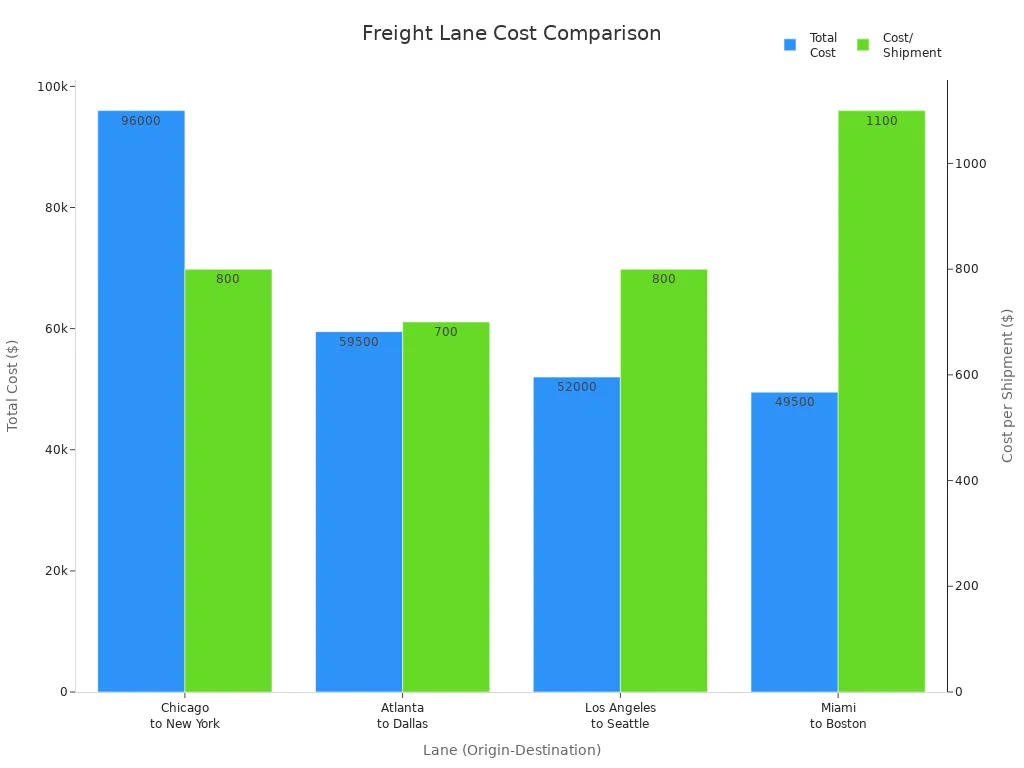
You can see some lanes cost more per shipment or have lower on-time rates. By checking this data, you can change your routes or modes to get better results. Big shippers who use managed transportation services often see an 8-15% drop in total transportation costs in 12-18 months.
Mode optimization also helps a lot. For example, a 2,500-pound shipment over 400 miles might cost $650 with LTL, but only $425 with partial truckload. That’s a 35% savings on one shipment.
Lane and mode optimization show why freight rfp best practices matter: you find hidden savings and get better service at the same time.
When you use these best practices in freight procurement, you see why they work. They help you make smarter choices, build stronger teams, and get more value from every dollar you spend. You turn your yearly rfps into a tool for ongoing improvement, not just a yearly job. This keeps your transportation procurement efficient and your costs under control.
Step-by-Step Freight Procurement Guide
Prepare Accurate Shipping Data
You need good shipping data before you start. Good data helps you avoid mistakes and surprise costs. When you get your data ready, you set yourself up to win. Here are the main steps:
Pick KPIs that show what success means for your business.
Make sure your buying and operations teams work together.
Change your carrier plan so you use more than one carrier. This lowers your risks.
Have the right people and technology ready for the RFP process.
Accurate shipping data helps you avoid extra fees. It makes things run smoother and helps carriers trust you. You can make better choices and stop arguments. Good data saves you money and keeps your freight buying on track.
Craft Clear, Concise RFPs
You need to write RFPs that are easy to understand. When you explain what you want, carriers give you better deals. Try these tips:
Say how you will pay and what your prices are.
Tell how long the contract lasts and how it can end.
Explain who pays if something is lost or broken.
List the rules and standards carriers must follow.
Clear RFPs help carriers know what you need. You get offers that fit your business and better prices. A good RFP makes everything open and fair.
Evaluate Responses for Value
You should check each carrier’s offer closely. Look for the best value, not just the lowest price. Compare service, trust, and cost. Use a table to keep track:
Carrier Name | Price | Service Level | Reliability | Extra Fees |
|---|---|---|---|---|
Carrier A | $800 | High | 98% | $50 |
Carrier B | $750 | Medium | 95% | $75 |
Carrier C | $900 | High | 99% | $40 |
Pick the carrier that gives you the best mix of price and service. This helps you save money and get better results.
Account for Accessorial Charges
You need to watch out for extra charges. These can make your freight cost more if you do not plan. Do these things:
Put every extra charge into a main cost group.
Find ways to stop or lower extra fees.
Work with your teams to check billed items.
Set rules for railcar moves and extra charges.
Check your freight details to avoid common fees like BOL corrections. Double-check codes to stop wrong charges. Use dock scheduling to load and unload faster. Look at bills and talk about extra fees in your yearly rfps. Doing this helps you keep costs down and makes your sourcing better.
Tip: If you use freight rfp best practices, your freight buying gets easier and you save money fast.
Avoiding Costly Mistakes in Freight Procurement
Common Pitfalls to Watch For
There are many risks in freight procurement. If you make mistakes, you can lose money and trust. Service can also get worse. Knowing about these problems helps you stay safe. Here is a table that shows common mistakes and how to fix them:
Mistake | Description | Solution |
|---|---|---|
Duplicate or Excess Orders | Employees may accidentally order more items than needed or duplicate orders. | Implement a purchasing approval workflow to prevent duplicate orders. |
Not Following Purchasing Protocol | Employees may bypass established protocols, leading to unregulated spending. | Establish a company-wide purchasing process for compliance. |
Employees may buy from unapproved vendors, risking higher costs and poor supplier relationships. | Use a centralized vendor management catalog to ensure compliance with approved suppliers. |
You need to watch out for these mistakes. Duplicate orders make costs go up and cause confusion. Not following rules means people spend money without a plan. Buying from the wrong vendors can hurt your business and make freight cost more. You can protect your company by making clear rules and using approval steps.
Tip: Check your procurement steps often. Make sure your team follows the rules and uses only approved vendors.
How Best Practices Prevent Losses
Best practices in freight procurement help you avoid big mistakes. They keep your sourcing smooth and safe. When you follow these steps, you build strong partnerships and lower risks. Here are ways best practices help you:
You can check if carriers are reliable and a good fit. This helps you pick the right ones.
Checking financial health stops problems. You do not need to find new carriers in a rush.
Using the right technology makes work easier and cuts mistakes.
Good talks with carriers help both sides win. You get better service and less risk.
Multi-year deals with market changes give you steady prices. You can handle changes better.
Watching performance all the time helps you spot problems early. You can fix things before they get worse.
Now you see why best practices are important in freight procurement. They help you save money, stop losses, and build good relationships. Your freight stays on track and your process stays strong.
Real-World Results: Fast Savings from Best Practices
Immediate Rate Reductions
You can save money fast with dynamic procurement strategies. Dynamic sourcing lets you change contracts and rates quickly. You do not need to wait for yearly cycles. You can run mini bids and make your RFPs simpler. This helps you get bids faster and change when the market moves. You get lower rates because you compare offers right away. Dynamic procurement gives you more control over freight costs. You can check contracts and find lanes that cost too much. You save money by picking better carriers or changing rates.
Eliminating Hidden Fees
Hidden fees make freight procurement cost more. You can avoid these costs with dynamic procurement best practices. You add more carriers to your network and get more choices. You use real-time contract checks to see if your rates are good. You change quickly when the market shifts and stop paying too much during rate spikes. The table below shows how these best practices help you stop hidden fees:
Best Practice | Benefit |
|---|---|
Streamlined RFPs and Mini Bids | Cuts time to collect bids and lets you change fast outside yearly cycles. |
Real-Time Contract Benchmarking | Shows if your rates are fair and helps you spot lanes that cost too much. |
Expanded Carrier Network | Gives you more choices and stops you from relying on only a few carriers. |
Data-Driven Flexibility | Lets you change fast when the market moves and stops overpaying during rate spikes. |
Note: Dynamic procurement helps you find and remove hidden fees before they hurt your budget.
Improved Carrier Performance
Dynamic procurement makes carrier performance better in freight procurement. You set clear goals and use KPIs to track results. You compare carrier rates and service levels fairly. You watch performance and find where costs go up. You build stronger relationships with carriers. You see more openness in your choices. You match your plan to carrier strengths. You make your freight procurement process easier and keep vendor checks fair. You set clear rules and push for better solutions. Better carrier performance means more efficiency, reliability, and sustainability. You get an advantage and make the most of your returns.
Better efficiency in freight procurement
More openness in your choices
Matching your plan to carrier strengths
Fair and steady vendor checks
Tip: Dynamic procurement gives you clear results and helps you reach your transportation goals faster.
When you follow freight RFP best practices, you save money fast. Automation helps you finish tasks quicker and lowers mistakes. It also helps you get better prices from carriers. Using data and technology gives you up-to-date information. This makes your work easier and helps you pay less. Working together with your team and vendors helps you make smarter choices.
Benefit | Description |
|---|---|
Time Savings | Automation can cut time on repeat tasks by up to 90%. This lets you spend more time on planning. |
Reduced Compliance Risk | Using the same templates and checking rules lowers errors. This means you are less likely to get disqualified. |
Improved Carrier Rates | Automated tools look at bids and suggest better prices. This helps you win more deals. |
Start now—look at your RFP steps, use new tools, and work with your team to save money fast.
FAQ
Why do mini-bids help you save money in freight procurement?
Mini-bids let you react fast to market changes. You can compare rates more often. This helps you avoid paying too much. You get better deals because carriers compete for your business. Mini-bids keep your costs low and your contracts flexible.
Why should you use mini-bids instead of waiting for yearly RFPs?
Mini-bids give you more control. You do not need to wait a whole year to adjust rates. You can fix problems or grab savings right away. Mini-bids help you stay ahead of market shifts and avoid long-term overpayments.
Why do shippers prefer mini-bids during volatile markets?
You face changing rates when the market moves fast. Mini-bids let you act quickly. You can lock in better prices or switch carriers if needed. This keeps your freight costs steady and protects your budget from sudden spikes.
Why do mini-bids improve carrier relationships?
Mini-bids open more chances to talk with carriers. You can solve issues faster. Carriers know you check performance often. This makes them work harder to win your business. Mini-bids build trust and keep service levels high.
Why are mini-bid freight contracts important for long-term savings?
Mini-bid freight contracts let you test new carriers and lanes without big risks. You can find the best fit for your needs. Over time, you learn which carriers offer the best value. This leads to smarter choices and more savings.
See Also
Maximize Savings With Premier Global Logistics' FTL Shipping
Three Strategies PGL Uses To Cut Your Trucking Costs
Enhancing Global Operations Through Innovative Logistics Solutions
