Freight Agent vs Freight Broker Comparison: Key Differences and Which Role is Right for You

You may ask what makes a freight agent different from a freight broker. In a freight agent vs freight broker comparison, it’s clear that freight brokers have legal authority and handle contracts, while freight agents work for brokers and assist in finding clients and carriers. Understanding these distinctions helps you select the right job in logistics. Consider these facts:
There are almost 26,000 freight brokers in the United States, with many agents operating independently under these brokers.
Learning about the differences between freight agents and freight brokers aids you in choosing a role that aligns with your skills and goals.
Key Takeaways
Freight agents help shippers and carriers talk. They do not need a license. They focus on selling and helping customers.
Freight brokers need a license. They have more duties. They handle contracts. They make sure rules are followed.
Both jobs let you work in different ways. Agents usually work alone. Brokers may work in big companies.
Pay is different for each job. Brokers can make more money because they do more work. Agents get paid for their sales.
Picking a job depends on what you want. Think about how much risk you like. Think about your career plans. Decide if you want to work alone or with others.
Freight Agent Overview

Role and Responsibilities
Freight agents help shippers and carriers work together. They make sure goods move quickly and safely. Agents find jobs for truck drivers and look for new clients. They plan when and where pickups and deliveries happen. Their main job is to connect people who need to ship things with people who move them. Agents talk about prices and help fix problems with routes. They use their skills to set up transportation and make sure things arrive on time. Agents help clients save money by finding good deals. Both freight agents and brokers are important, but agents spend more time making friends and solving problems fast.
Tip: If you like meeting people and fixing problems, being a freight agent lets you do this every day.
Agents also answer questions and help customers. They make sure shipments get where they need to go. You do not need a license to be a freight agent. But you should know the rules and how things work in freight. Many agents work alone and choose their own hours. They run their own business.
Work Environment
Freight agents have flexible jobs. They pick their own hours and work from anywhere. Most agents work from home using phones and computers. They do not need to go to an office. They can work anywhere with internet.
Freight agents get paid by commission. They earn money for each load they handle.
You need to work hard because your pay depends on your effort.
Independent agents can earn between 25% and 70% of the gross margin. Most agents earn between 50% and 65%.
Freight agents get rewarded for working hard and not giving up. If you want a job with freedom and high earning chances, being a freight agent could be a good fit for you.
Freight Broker Overview
Role and Responsibilities
Freight brokers help shippers and carriers work together. They make sure goods get moved the right way. Brokers help save time and money for both sides. They look at market trends to find the best shipping options. Brokers talk to clients and carriers about prices. They make sure everyone follows the rules. If shipments are late or there are mistakes, brokers fix the problems. They keep track of loads and tell everyone where things are. Brokers build trust with clients and carriers by helping them often.
Connect shippers and carriers.
Make sure freight moves smoothly.
Help clients save money.
Study market data for smart choices.
Share updates and fix problems.
Negotiate contracts and prices.
Follow all laws and rules.
Build trust with clients and carriers.
Note: You need to talk well and think fast to do well as a freight broker.
Legal Requirements
Freight brokers must follow strict rules. You need to pick a business type, like LLC or corporation. You must apply for broker authority with the FMCSA using Form OP-1. You need a $75,000 surety bond to show you will follow the rules. You must choose process agents in every state you work in. You also need insurance for your business and cargo.
Learn about the freight industry.
Pick your business type.
Apply for broker authority with FMCSA.
Get a $75,000 surety bond.
Choose process agents for each state.
Show proof of bond or trust fund to FMCSA.
Tip: Doing these steps helps you stay out of trouble and build a strong business.
Work Environment
Freight brokers work in bigger companies or run their own business. They handle bills, pay agents, and make sure carriers get paid. Brokers work on their own and set their own rules. They create a steady office culture. Brokers manage many jobs and watch over agents who help them.
Aspect | Freight Broker | Freight Agent |
|---|---|---|
Company Size | Bigger companies | Small businesses from home |
Responsibilities | Handle bills, pay agents, pay carriers | Build client relationships, book business |
Operational Independence | Work on their own | Work under broker’s rules |
Cultural Environment | Steady office culture | Independent contractors with own culture |
Brokers control their business and make big choices. They take on more risk and responsibility. But they can earn more and grow their company.
Freight Agent vs Freight Broker Comparison
Key Differences
When you compare a freight agent and a freight broker, you see they are not the same. They have different rules, jobs, and freedom. You should know these differences before you pick a job in freight.
Here is a table that shows how they are different:
Aspect | Freight Broker | Freight Agent |
|---|---|---|
Authority and licensing | Must get their own authority and licenses from FMCSA | Works under the authority and licensing of a broker |
Business independence | Runs their own business and builds relationships | Acts as a helper, focusing on sales and service |
Liability and risk | Takes on more risk and must follow rules | Has less risk, covered by broker's insurance |
A freight broker needs a license and has more risk. They must follow strict rules and handle legal problems. A freight agent works under a broker’s license. They focus on sales and helping customers. They do not worry about legal rules.
Note: If you want more freedom and control, you may like being a broker. If you want less risk and more help, being an agent may be better.
You should think about risk too. Here are some things to remember:
Freight brokers must follow all the rules.
Freight agents work under brokers and do not have to worry about rules.
Brokers have more responsibility. Agents spend more time making friends and booking shipments.
Earnings Potential
Money is important when you compare freight agents and brokers. You want to know how much you can make. Your pay depends on your skills, job type, and where you live.
Here is a table that shows how much you can earn:
Role | Typical Annual Income |
|---|---|
Freight Agent | $40,000–$90,000 |
Freight Broker Agent | $50,000–$100,000 |
Independent Freight Broker | $60,000–$150,000+ |
Freight brokers can earn more, especially if they run their own business. Freight agents earn money from each load they book. Your pay goes up as you get better and find more clients.
Different freight jobs pay different amounts. Look at this chart to see how much you can earn:
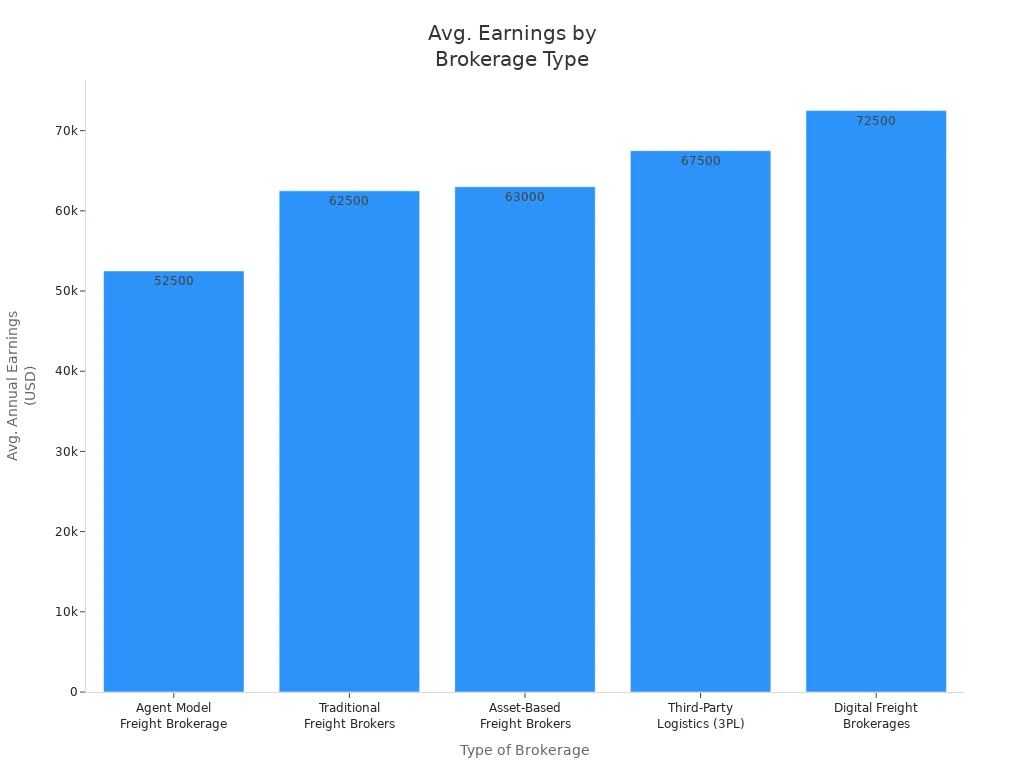
Digital freight brokers and third-party logistics companies pay more. Your pay may start low if you are new. As you learn and get more clients, you earn more.
Here are some things that change your pay:
Cost of Living: You earn more in big cities because things cost more.
Demand and Volume of Business: Busy places with lots of freight have more jobs.
Market Competition: More competition can mean better pay and rewards.
Tip: If you want to earn more, make strong friendships and learn new skills.
Career Path
Your career path is important when you compare freight agents and brokers. You want to know where each job can take you.
Freight agents can move up in steps:
Level | Position | Responsibilities |
|---|---|---|
1 | Entry-Level Position: Freight Clerk or Logistics Assistant | Handle basic paperwork, learn freight steps, help with tracking and talking to people |
2 | Cargo/Freight Agent | Book and plan shipments, help with customs, work with carriers and logistics companies |
3 | Senior Freight Agent / Logistics Coordinator | Manage big shipping jobs, talk about contracts, help junior agents |
4 | Freight Forwarding Manager | Lead a team, plan ways to save money, handle big international shipments |
5 | Director of Logistics / Supply Chain Manager | Watch over global supply chains, use new technology, make deals with carriers and suppliers |
You start as a clerk or helper. You learn and move up to agent jobs. With more experience, you can be a manager or director.
Freight brokers have many choices:
Career Path | Description |
|---|---|
Specialization | You can focus on certain freight or ways to ship. |
Management Roles | You can become a manager in a brokerage company. |
Business Development | You can grow the business and find new clients. |
Self-Employment | You can start your own brokerage if you have experience. |
You can be a logistics account executive. You build client friendships and grow your work. You can focus on certain freight or places. You can also start your own brokerage.
Logistics Account Executive: You work with clients and help them. You get better at your job.
Freight Broker: You get training and can focus on special freight or places.
Note: If you want to lead teams or start your own company, the broker path gives you more choices. If you want to focus on sales and helping customers, the agent path is a good way to succeed.
Think about your goals and what you are good at. Comparing freight agents and brokers helps you pick the best job for your future in freight.
Choosing the Right Role
Skills and Personality Fit
You need certain skills and the right personality to do well in freight. If you want to try freight sales, think about what you are good at. Here are some important traits for freight agents:
Communication helps you make strong friendships with clients and carriers.
Strategic planning lets you study the market and give smart advice.
Resilience helps you get better and deal with hard times.
Efficiency means you use tools and keep things neat.
You should also think about these qualities:
Self-motivation pushes you to reach goals and keep customers happy.
Staying calm under pressure helps you fix problems fast.
Networking brings new chances and helps your business grow.
If you like talking to people, fixing problems, and working alone, being a freight agent may be good for you. If you want to lead teams, make big choices, and handle more responsibility, you may like being a freight broker.
Startup and Risk Considerations
When you pick between freight agent and freight broker, look at costs and risk. The table below shows common costs:
Category | Freight Broker Costs | Freight Agent Costs |
|---|---|---|
LLC/Corp | $100 – $400 (one time) | $100 – $400 (one time) |
Freight Broker License | $300 (one time) | Not Required |
BOC3 | $25 (one time) | Not Required |
Freight Broker Surety Bond | $1,500 – $3,750 (annually) | Not Required |
Freight Broker Training | $185 – $1,000 (one time) | $185 – $1,000 (one time) |
UCR | $59 (annually) | Not Required |
TMS | $50 – $100 (monthly) | $0 – $100 (monthly) |
Load Board | $50 – $150 (monthly) | $50 – $150 (monthly) |
General Liability Insurance | $300 – $1,000 (yearly) | $300 – $1,000 (yearly) |
Contingent Cargo Insurance | $100 – $400 (monthly) | Not Required |
Website | $250 – $500 (one time) | $0 – $500 (one time) |
Phone | $25 – $50 (monthly) | $25 – $50 (monthly) |
Total One Time Investment | As low as $2,219 | As low as $175 |
Total Recurring Cost | As low as $100/month | As low as $75/month |
Freight brokers pay more to start and follow more rules. You need to be okay with taking bigger risks. Freight agents pay less and have fewer tasks. You can work more freely and have less money risk.
Everyone is different when it comes to risk. If you want a steady job, being an agent may be best. If you want to own a business and earn more, being a broker gives you more chances.
Use this checklist to help you choose:
Do you want to own a business and take more risk?
Are you okay with legal and money duties?
Do you want flexible work and lower costs?
Are you excited by sales and making friends?
Do you want to grow your career with more chances?
Your choice depends on your goals, how much risk you want, and what you have. Both jobs give you special freight chances and ways to grow.
Pros and Cons
Freight Agent Pros and Cons
Working as a freight agent has many good points. You pick your own work hours. You decide when you want to work. You can earn high commissions, sometimes up to 70% per deal. You choose which clients you want. You build your own business friendships. You do not pay big costs to start a freight brokerage. You can save money by deducting health insurance from your taxes. You run your own business and enjoy being your own boss.
Advantages of being a freight agent:
Flexible work hours
High commission earnings
Pick your own clients
Lower costs to start
Tax savings for health insurance
Make your own business choices
But there are some hard parts too. Small freight brokers may not have steady money. You might have fewer tools than big companies. You may not offer as many services as large brokers. When you give a shipment to the broker, you lose some control. You might pay extra fees because brokers are in the middle. Sometimes, brokers do not talk well, and this can confuse you. Some brokers do not have enough experience, and this can hurt your results.
Disadvantage | Description |
|---|---|
Financial Stability | Small freight brokers may not be steady |
Resources | Fewer tools than big companies |
Service Offerings | Not as many services as large brokers |
You may also have trouble with prices that change a lot. You may have fewer carriers to pick from. Learning new technology can be hard. The market changes and small profits make things tough.
Freight Broker Pros and Cons
Freight brokers have more responsibility but also more control. You make your own business rules. You manage your team. You can grow your company and earn more money. You build strong friendships with shippers and carriers. You can focus on special types of freight and offer more services.
Advantages of being a freight broker:
Full control of your business
Can grow your company bigger
Can focus on special freight types
Build strong client and carrier friendships
There are also some problems. Bad communication can make shippers upset and planning hard. Service quality can change and make clients unhappy. Hidden fees and price changes can make people not trust you. You must keep prices fair and build a good carrier network. There is no promise you will always find carriers, especially when it is busy.
Tip: If you want to lead and grow a business, being a broker gives you more control. But you must handle more risk and responsibility.
You can tell freight agents and freight brokers are not the same. Agents work on their own and can earn more money. Brokers usually get a set salary and limited commission. Both jobs have good chances to grow and succeed. Think about what you are good at before you pick. Also, think about your goals and how much risk you like. Look at your shipper and carrier contacts. Check your marketing skills and money. If you want a good job in logistics, choose the role that fits you best. 🚚
FAQ
Why should you consider becoming a freight broker?
You can control your business and make important decisions. You handle contracts and build strong relationships. You earn more as your company grows. You learn new skills and gain experience in logistics.
Why do freight agents work under a broker?
You avoid legal risks and licensing costs. You focus on sales and customer service. You get support from the broker’s experience. You learn the business before starting your own company.
Why does a freight broker need a license?
You need a license to follow government rules. You show clients and carriers you are trustworthy. You protect your business from legal problems. You meet industry standards and build a good reputation.
Why do earnings differ between agents and brokers?
You earn more as a broker because you take on more responsibility. You set your own rates and manage contracts. Agents earn commissions but have less risk and fewer costs.
Why is networking important in freight brokerage?
You find new clients and carriers through networking. You build trust and grow your business. You learn about market changes and new opportunities. Networking helps you succeed as a freight broker or agent.
See Also
Deciding on LTL, FTL, or Drayage for Your Shipping
PGL Offers Expert Solutions for LTL and FTL Shipping
Premier Global Logistics Enhances West Coast Freight Services
