Freight Class Codes Guide: Understanding NMFC Codes and Shipping Classification
Imagine you need to send a pallet of electronics far away. You want a good price, but you also want your things to be safe. The freight class codes guide helps you choose the best way to ship. NMFC codes sort your freight by density, stowability, handling, and liability. If you use the right freight classification, you save money, follow carrier rules, and keep your items safe. If you make mistakes, you might pay more and have more problems. Here is how wrong classification can hurt your shipping:
Impact of Incorrect Freight Classification | Description |
|---|---|
Wrong tariffs mean you pay more money. | |
Higher Claims Rates | Wrong classification can cause more mistakes in handling. |
Reclassification Charges | Carriers may charge extra to fix wrong freight details. |
To stop these problems, always check nmfc rules before you book your next shipment.
Key Takeaways
Pick the right NMFC codes to help save money and stop shipping issues.
Look at the newest NMFC changes before you ship to avoid paying more.
Measure and weigh your shipments well to find the right freight class.
Think about density, handling, stowability, and liability when you choose a freight class.
Use online tools and ask experts to make sure you pick the right freight class.
Freight Class Codes Guide: What Are NMFC Codes?
NMFC System Overview
If you want to ship freight the right way, you need to know about the NMFC system. The National Motor Freight Classification, or NMFC, is a standard that people use in North America. It helps you compare different things that are shipped across states and countries. The NMFC system puts items into 18 different freight classes. These classes go from 50 up to 500. If your item has a lower number, it is heavy and easy to move. If your item has a higher number, it is light, big, or needs special care.
The National Motor Freight Traffic Association (NMFTA) makes and updates the NMFC. The Freight Classification Development Council (FCDC) helps NMFTA keep the system current. NMFTA gives out new updates every three months. You should always know about these changes to keep your shipping easy.
Tip: Check the newest NMFC codes before you ship. This helps you stop mistakes and extra costs.
How Freight Classes Are Determined
You pick a freight class by looking at four main things. These things help you see how simple or hard it is to move your shipment. The four main things are:
Density: This means how much your freight weighs compared to its size. If your item is less dense, it gets a higher class.
Handling: If your shipment is hard to move or needs special care, it gets a higher class.
Stowability: This shows how well your items fit with other shipments in a trailer. If your items do not fit well, they get a higher class.
Liability: If your items are worth a lot or break easily, they get a higher class.
You need to measure and weigh your shipment the right way. You also need to think about how you pack your items and if they need special care. The NMFC system uses these four things to make sure every shipment gets the right class.
Why Classification Matters
You have to use the right freight classification for every shipment. If you use the wrong class, you might have problems like delays, extra charges, or even denied claims. Carriers can look at your shipment and change the class if they find mistakes. This can mean you pay more and your delivery is slower.
The NMFTA helps you get the right class. They give you tools, training, and help to understand the NMFC system. They also work with carriers and shippers to keep things fair.
Note: Using the right classification keeps you safe from problems and helps you save money.
The freight class codes guide gives you the facts you need to ship with confidence. When you follow the NMFC codes, your freight moves safely and without trouble.
Key Factors in Freight Classification
Density and Measurement
You need to know the density of your freight to assign the right freight classification. Density means how much your shipment weighs compared to its size. To find density, measure the length, width, and height of your package in inches. Multiply these numbers to get the cubic inches, then divide by 1,728 to get cubic feet. Next, divide the weight in pounds by the cubic feet. This gives you the density in pounds per cubic foot.
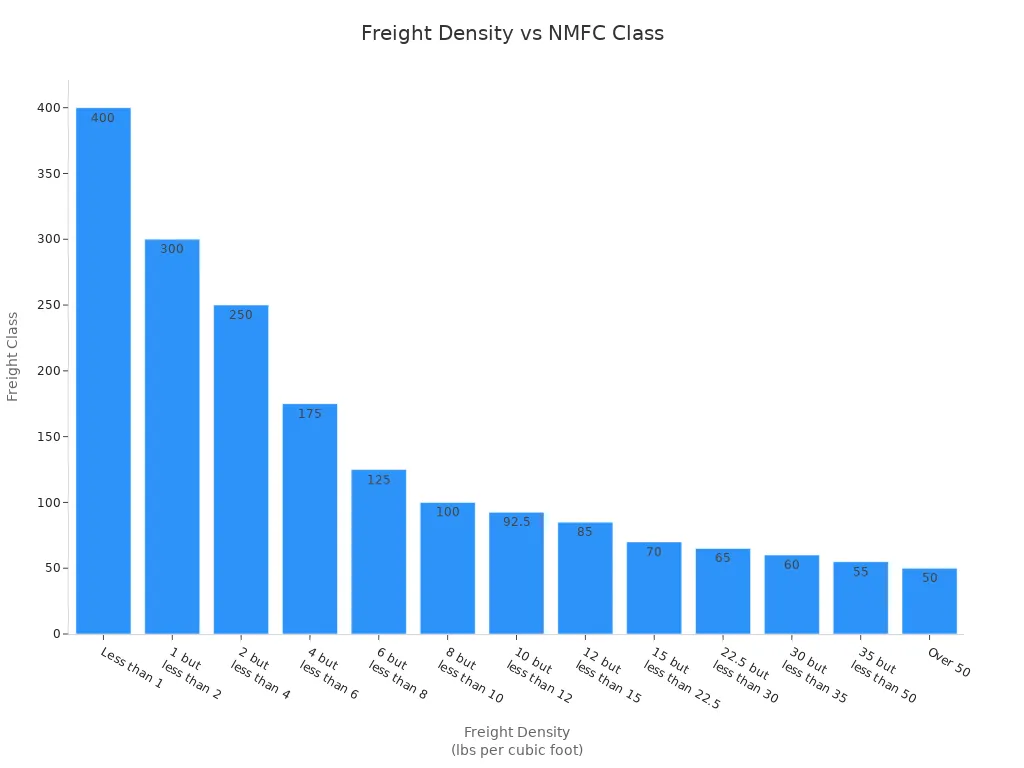
Here is a table that shows how density matches with freight class:
Freight Density (in lbs per cubic foot) | Freight Class |
|---|---|
Less than 1 | 400 |
1 but less than 2 | 300 |
2 but less than 4 | 250 |
4 but less than 6 | 175 |
6 but less than 8 | 125 |
8 but less than 10 | 100 |
10 but less than 12 | 92.5 |
12 but less than 15 | 85 |
15 but less than 22.5 | 70 |
22.5 but less than 30 | 65 |
30 but less than 35 | 60 |
35 but less than 50 | 55 |
Over 50 | 50 |
To measure your freight, you can use tools like Parcel Ultima Pro, Pallet Ultima Pro, or a Dimensional Weight Scanner. These tools help you get accurate numbers, which is important for correct freight classification.
Stowability and Handling
Stowability looks at how well your freight fits with other shipments in a truck. If your items are odd-shaped or hazardous, they may need special storage. This can raise your freight class because it makes transportation harder. You want your freight to stack and fit easily to keep costs down.
Handling checks how easy it is to move your shipment. If your freight needs special equipment or extra care, it gets a higher class. Carriers look at how your freight is packed and if it can be loaded or unloaded without problems.
Stowability affects NMFC codes for irregular or hazardous items.
Irregular shapes or dangerous goods often need special storage.
Special handling increases the freight class.
Liability Considerations
Liability means the risk of damage, theft, or loss. If your freight is valuable or fragile, it gets a higher class. Carriers want to know if your shipment needs extra protection. You should pack your freight well and label it clearly. This helps lower the risk and keeps your shipment safe during transit.
Tip: Always check if your freight needs extra insurance or special handling. This can help you avoid problems and extra costs.
How to Assign the Correct Freight Class
Step-by-Step Freight Classification
You need to follow some steps to pick the right freight class. This helps you stop mistakes and extra fees. The NMFTA says to do these things:
Measure and Weigh
Use a tape measure to check the length, width, and height in inches. Weigh your shipment in pounds. Make sure you count the packaging too.Calculate Volume
Multiply the length, width, and height together. This gives you the total cubic inches. Divide that number by 1,728 to get cubic feet.Calculate Density
Take the weight in pounds and divide it by the cubic feet. This tells you the pounds per cubic foot. Density is key for picking the freight class.Determine Freight Class
Use the density to find the freight class in the NMFC book or online. Each class has its own density range and handling needs.Identify NMFC Number
Find the NMFC number that matches your shipment’s type and density. You need this number for booking and paperwork.
Tip: Always measure your shipment. Do not guess. Guessing can cause mistakes and cost more money.
Using NMFC Codes and Directories
You should check official sources to make sure your freight class and NMFC code are right. The NMFTA makes the official NMFC directory. You can use online tools to look up codes faster. Here are some trusted places:
Source | Description |
|---|---|
NMFTA Official NMFC Guide | The NMFTA gives out the real NMFC codes and keeps the list updated. |
FreightCenter NMFC Code Lookup Tool | This tool helps you find NMFC codes quickly and easily. |
Use these directories to double-check your freight class before you ship. The NMFTA updates the list often to match new changes. If you are not sure, ask your carrier or freight forwarder for help.
Note: Talking with your carrier or freight forwarder helps you avoid mistakes. It also makes sure your shipment follows all the rules.
Common Tools and Resources
There are many digital tools to help you figure out freight class. These tools save time and help you make fewer mistakes. Here are some popular ones:
ClassIT+
This tool lets you search for NMFC codes and save your searches. You can use it on your phone or computer.FreightSideKick
This tool has a density calculator for fast freight class checks.FedEx Freight Class Calculator
You can use this tool to find your freight class by density.FreightCenter
This site has a freight class calculator and NMFC lookup tool.XPO Logistics Freight Class Calculator
This is another tool to check your freight class.ArcBest
This tool gives you an NMFC lookup and a density calculator.
You can also use guides from Mobile Dimensioning, GOCOMET, and IncoDocs to learn more about NMFC codes.
Method | Pros | Cons |
|---|---|---|
Freight Class Calculator | 1. Accuracy: Gives more correct and steady results. | 1. Potential Errors: Mistakes can happen if you enter wrong data. |
2. Time-Saving: Saves you lots of time and work. | 2. Limited Customization: May not work for special shipments. | |
3. Consistency: Uses the same method each time, so fewer mistakes. | 3. Dependence on Third-Party Tools: Needs outside tools to work right. | |
Manual Calculation | 1. Customization: You can change it for your needs. | 1. Time-Consuming: Takes a lot of time and effort. |
2. Control: You have more control over each step. | 2. Inconsistency: People can make mistakes. | |
3. Familiarity: Some people like doing it by hand. | N/A |
Tip: Use digital tools for most shipments. Double-check if your freight is special or different.
You should always talk with your carrier or freight forwarder. They can help you check your freight class and NMFC code. Working together helps you avoid extra charges and late shipments.
Freight Class and Shipping Costs
Rate Calculation
It is important to know how freight class changes shipping costs. Carriers use freight class to set prices for shipments that do not fill a truck. This system puts your goods into groups by density, stowability, handling, and liability. Each group has a number from 50 to 500. Lower numbers mean you pay less. Higher numbers mean you pay more. Carriers use these numbers to keep prices fair for everyone.
Freight class helps carriers give the right price.
Every item gets an NMFC code. This helps carriers see how hard it is to ship.
If you use the wrong class, you may pay extra fees.
You can save money by picking the right class and checking your NMFC code before you book.
Carrier Selection
Carriers use NMFC codes to see if they can ship your items. They look at things like density, handling, stowability, and liability. These things help carriers set prices and see if your shipment fits their trucks.
Factor | Description |
|---|---|
Density | How heavy the item is compared to its size. |
Handling | How easy or hard it is to move the item. |
Stowability | How well the item fits in a container. |
Liability | The chance of damage, theft, or loss. This changes insurance and costs. |
Every product has a freight class and an NMFC code. Some NMFC codes are different even in the same class. Carriers use this to set prices and decide if they will ship your items.
Operational Efficiency
Using the right NMFC code helps your shipping go smoothly. When you use the correct codes, carriers can load and move your items faster. This helps use space better and makes delivery quicker. You also avoid delays and extra costs.
Using the right code helps with handling and cost control.
NMFC codes help carriers use space and plan routes better.
Freight class calculators and digital tools help stop mistakes and keep prices right.
Tip: Use digital tools and check your NMFC codes. This helps keep shipping costs low and prices correct.
Mistakes and Best Practices in Freight Classification
Common Errors
People can make mistakes when they pick a freight class. If you use the wrong NMFC code, you might pay extra fees. You could also get audit changes or lose money from clients. These problems can lower your profits and hurt your carrier relationships.
Type of Cost | Description |
|---|---|
Reclassification Fees | Extra charges if you pick the wrong freight class |
Delivery Delays | Shipments take longer if the class is checked again |
Chargebacks | Clients may fine you for late shipments |
Some mistakes happen a lot:
Guessing density or not measuring freight right
Using old NMFC codes
Not thinking about special handling or packaging
Thinking similar items always have the same class
🚩 If you use the wrong class, your shipment can be late. You might lose sales or have to pay clients if things arrive late.
Tips for Accurate Classification
You can stop mistakes by following good steps. Always measure and weigh every shipment carefully. Use the newest NMFC codes and check them before you ship. Teach your team how to find density and spot special handling needs.
Check the freight class before you send an invoice.
Train your team to do density math the right way.
Write down the exact weight and size for each shipment.
Review shipments before sending to catch mistakes early.
Keep up with NMFC code changes to avoid errors.
💡 Tip: Always check your freight class before you ship. This easy step can save money and stop problems.
Role of Freight Forwarders
Freight forwarders can help you pick the right class. They know the NMFC system and can help you with the process. A good freight forwarder checks your info, looks at your packaging, and helps you avoid extra fees. They also know about NMFC updates and can answer your questions.
You can count on a freight forwarder to:
Check your NMFC codes and freight class
Give advice on packaging to lower risk and cost
Handle paperwork and talk to carriers
Working with a freight forwarder helps you feel safe. They help you avoid mistakes and extra costs when picking a freight class.
You can keep shipping costs steady if you use NMFC codes right. When you classify items correctly, you make fewer mistakes. This helps you know what you will pay for shipping. If you follow the guide’s steps, you can plan your shipping budget better. You also lower the chance of paying extra fees or having late shipments.
Benefit | Description |
|---|---|
Less Fixing Needed | You do not have to fix shipping mistakes as much. |
Fewer Mistakes | You are less likely to pick the wrong class and pay more. |
Steady Shipping Costs | Shipping prices stay the same and are easier to plan for. |
Easier to Track Costs | You can see and manage shipping costs more easily. |
Keep learning about NMFC codes to save money.
Ask experts or freight forwarders if you need help.
Use good tools and check for NMFC updates often.
Stay up to date and use helpful resources to keep shipping costs steady.
FAQ
What are the main guidelines for choosing the correct freight class?
You need to follow some simple steps. First, measure and weigh your shipment. Next, look up the NMFC directory. Use the right density and handling details. Always check the newest rules before you book your shipment.
How often do NMFC guidelines change?
NMFC guidelines change every three months. You should check for updates before each shipment. This helps you avoid mistakes and extra costs.
Why do carriers require you to follow NMFC guidelines?
Carriers use NMFC guidelines to set prices and lower risk. If you follow these rules, carriers can move your freight safely. You also avoid extra fees for wrong classes.
Can you use online tools to follow NMFC guidelines?
Yes, you can use online calculators and lookup tools. These tools help you check density and class. Always double-check your answers with the official rules.
What happens if you ignore NMFC guidelines?
If you ignore the rules, you may pay more money. Your shipment could be delayed or denied. Carriers might change your shipment’s class. Always follow the guidelines to keep your shipment safe and save money.
See Also
PGL Handles West Coast Freight From Bulk To FBA
Comprehensive Ocean Export Services For FCL And LCL From U.S. Ports
Simplifying West Coast Cross-Border Freight With Premier Global Logistics
