Largest Freight Forwarders Market Share: Top Players and Global Market Breakdown
Kuehne + Nagel holds the largest freight forwarders market share at 8.7%. Following closely are DSV Panalpina, DHL Global Forwarding, and DB Schenker. These top companies play a crucial role in shaping the market dynamics and setting the pace for global freight. Understanding who leads in logistics provides valuable insights, aiding in the selection of partners, investment planning, and supply chain management.
Key Takeaways
Kuehne + Nagel is the biggest in freight forwarding with 8.7% market share. DSV Panalpina and DHL Global Forwarding come next. Knowing these top companies helps you pick good partners.
Asia-Pacific is the leader in global freight forwarding. This is because of fast economic growth and strong factories. Working with top companies here can make your logistics better.
Learning about market share in each region helps you choose how to ship. Every region has special strengths that help your supply chain.
Technology is changing how logistics works. Digital tools help with tracking, pricing, and making things faster. It is important to keep up with these new tools.
Watching market trends and data helps you change your logistics plans. Use this information to save money and make shipping better.
Top Global Freight Forwarders
Market Share Leaders
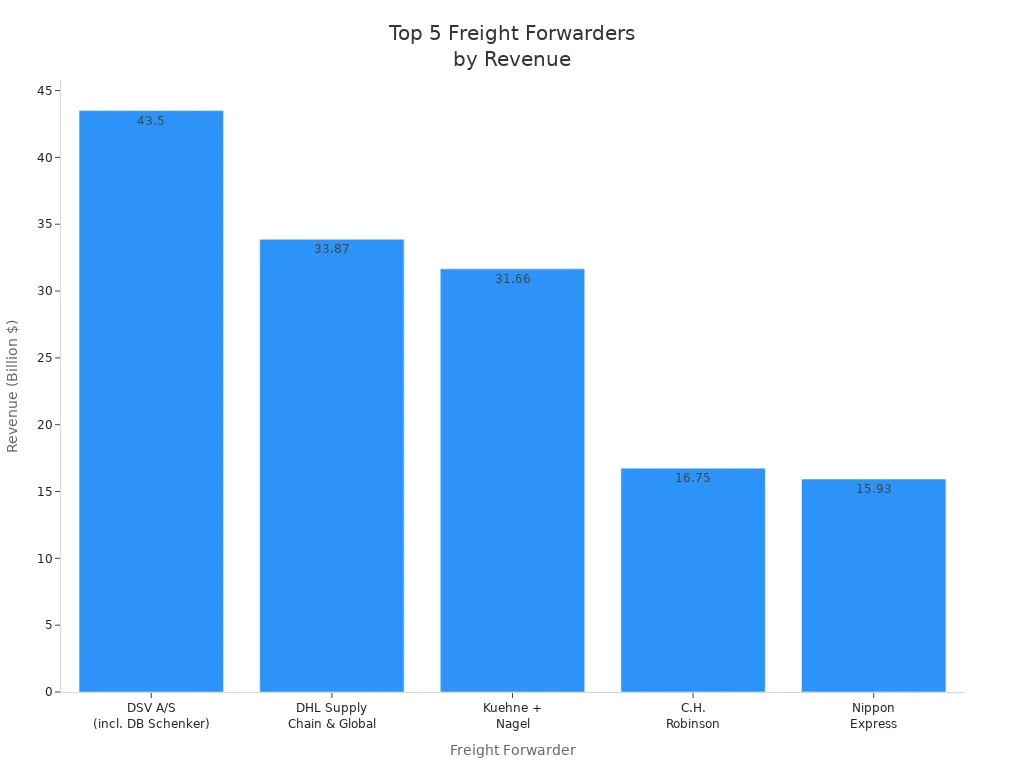
A few top companies have the largest freight forwarders market share. These leaders move a lot of goods around the world. The table below lists the top five global freight forwarders by revenue. This helps you see which companies control most freight and logistics work worldwide.
Rank | Freight Forwarder | Revenue (in Billion $) |
|---|---|---|
1 | DSV A/S (including DB Schenker) | 43.5 |
2 | DHL Supply Chain & Global Forwarding | 33.87 |
3 | Kuehne + Nagel | 31.66 |
4 | C.H. Robinson | 16.75 |
5 | Nippon Express | 15.93 |
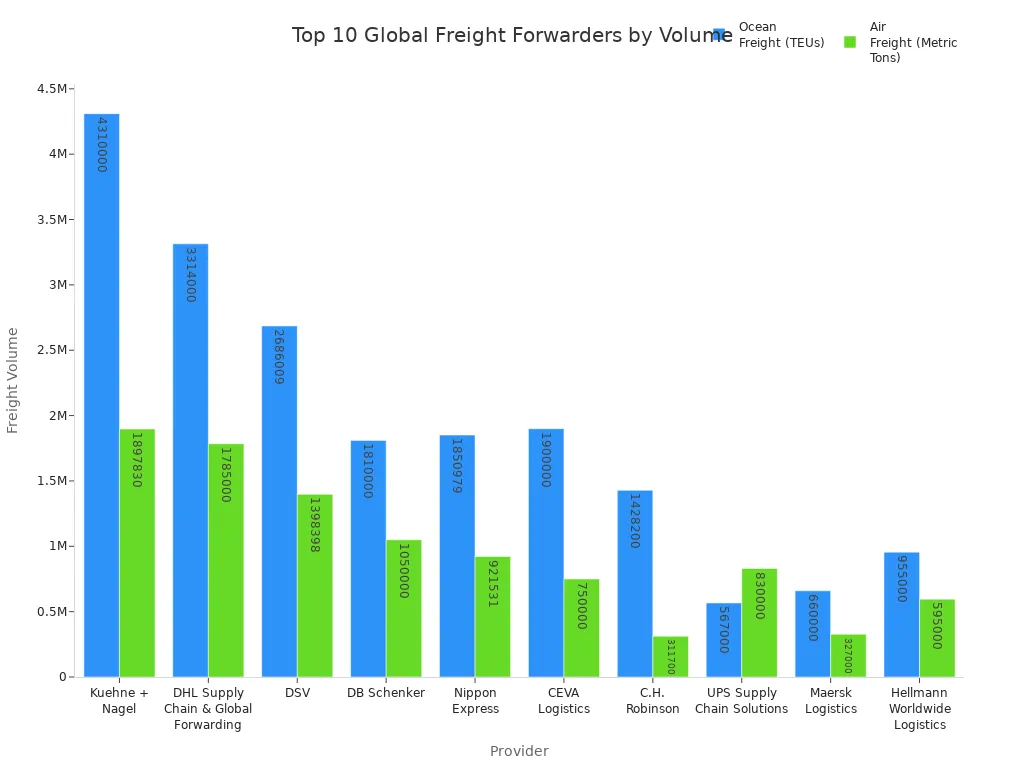
The top freight forwarders also stand out in freight volume. Kuehne + Nagel moves about 4.3 million TEU in ocean freight. DHL Global Forwarding ships about 3.3 million TEU. DSV moves 2.7 million TEU, and DB Schenker ships 1.8 million TEU. Sinotrans, a big company in Asia, ships about 4.8 million TEU. These numbers show how much these companies move goods across the world.
The largest freight forwarders market share is not only about money. It also depends on how much freight each company moves and how many countries they work in. The table below shows more details about the top freight forwarders by revenue, ocean, and air freight volume.
Rank | Provider | Headquarters | Gross Logistics Revenue (US$ Millions) | Ocean (TEUs) | Air (Metric Tons) |
|---|---|---|---|---|---|
1 | Kuehne + Nagel | Switzerland | 30,283 | 4,310,000 | 1,897,830 |
2 | DHL Supply Chain & Global Forwarding | Germany | 33,542 | 3,314,000 | 1,785,000 |
3 | DSV | Denmark | 23,335 | 2,686,009 | 1,398,398 |
4 | DB Schenker | Germany | 19,970 | 1,810,000 | 1,050,000 |
5 | Nippon Express | Japan | 17,005 | 1,850,979 | 921,531 |
Key Strengths of Top Players
It is important to know what makes each top freight forwarder special. Their strengths help them lead the global logistics market and offer good freight forwarding services.
Kuehne + Nagel
Kuehne + Nagel works in more than 100 countries and has over 1,300 locations. This company helps many industries, like high tech, industrial products, perishables, and pharmaceuticals. Kuehne + Nagel offers order management, warehousing, supply chain consulting, and project management. The company also cares about sustainable logistics solutions.DSV Panalpina
DSV has a huge global network and is strong in European road transport. After buying Panalpina and DB Schenker, DSV became one of the largest freight forwarders by revenue. The company improved road services in Germany and offers many freight forwarding services.DHL Global Forwarding
DHL works in over 190 countries. You can count on DHL for global reach and industry-specific solutions. The company provides freight forwarding services in Europe, Russia, and the Middle East. DHL’s network helps you manage imports and exports almost everywhere.DB Schenker
DB Schenker is in more than 130 countries. The company focuses on air, land, sea, and contract logistics. DB Schenker’s services help you move freight easily across continents.Expeditors International
Expeditors is known for custom logistics solutions and great customer service. The company works with high-value cargo and offers flexible shipping options.
Note: The largest freight forwarders market share comes from global coverage, high freight volume, and strong logistics services. These top freight forwarders change how goods move in international trade.
The global freight forwarders with the biggest market share succeed because of wide network coverage, advanced technology, and a focus on customer needs. If you choose a partner from these top companies, you get reliable shipping, strong transportation networks, and expert logistics support.
Largest Freight Forwarders Market Share by Region
Knowing the largest freight forwarders market share by region helps you make smart choices. You can see which companies are leaders in each area. Their strengths can change your supply chain. This section explains how to look at the global market by region. You can use this information to make your shipping better.
Asia-Pacific Market Breakdown
Asia-Pacific is the top region for global freight forwarders. This is because the economy grows fast, manufacturing is strong, and e-commerce is booming. If you want to ship goods in or out of Asia, you should know the main companies.
Here are the top freight forwarders by revenue and volume in Asia-Pacific:
DHL Global Forwarding
Kuehne+Nagel International
DSV
Expeditors International of Washington
C.H. Robinson Worldwide
Kerry Logistics Network
Dimerco Express
These companies have strong freight forwarding services. They built networks that reach deep into Asian manufacturing hubs. You can use their services to connect with factories, ports, and distribution centers in China, Southeast Asia, and India. Many of these forwarders also offer advanced supply chain solutions and digital tools. These help you track shipments and manage logistics.
Asia-Pacific’s market share keeps growing. This is because there is high demand for international shipping and good transportation systems. If you want to grow your business in this region, working with these global freight forwarders gives you reliable logistics services and local knowledge.
Europe and North America Leaders
Europe and North America are also important in the global logistics market. These regions have strong infrastructure, advanced technology, and many freight forwarding services. The largest freight forwarders market share often comes from companies with long histories in these areas.
The table below shows the market share percentages of top countries in Europe and North America:
Region | Country | Market Share (%) |
|---|---|---|
North America | United States | 76.48 |
Canada | 13.14 | |
Mexico | 10.38 | |
Europe | United Kingdom | 8.80 |
Germany | 15.60 | |
France | 9.70 | |
Italy | 4.10 | |
Russia | 14.20 | |
Spain | 6.70 | |
Sweden | 4.25 | |
Denmark | 4.30 | |
Switzerland | 3.60 | |
Luxembourg | 2.70 | |
Rest of Europe | 26.05 |
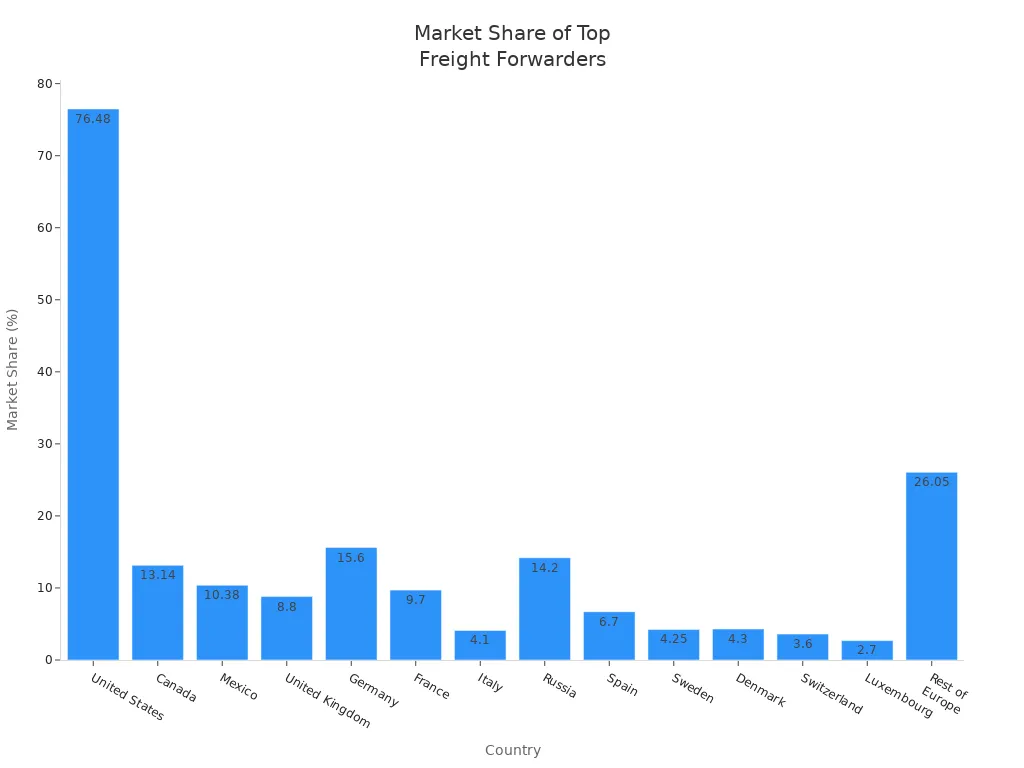
The United States leads North America. Germany and Russia have big shares in Europe. These countries have strong transportation networks and advanced logistics systems. You can trust their freight forwarders for both international and domestic shipping.
The top freight forwarders in these regions are DHL Supply Chain, Kuehne + Nagel, and DSV Global. Each has about 8% of the market share. These companies offer many freight forwarding services. They move goods by air, ocean, road, and rail. If you need to ship goods across borders in Europe or North America, these forwarders are good choices.
Freight Forwarder | Market Share |
|---|---|
DHL Supply Chain | 8% |
Kuehne + Nagel | 8% |
DSV Global | 8% |
DB Schenker | N/A |
Regional Differences
There are clear differences in how the largest freight forwarders market share is spread across regions. Asia-Pacific leads because of fast economic growth, manufacturing, and e-commerce. Europe is known for strong road and rail networks and strict rules. North America has mature logistics infrastructure and advanced technology.
Region | Key Characteristics |
|---|---|
Asia-Pacific | Leading in market share due to rapid economic growth, manufacturing, and e-commerce industries. |
Europe | Strong road and rail networks, diverse industries, and regulatory compliance affecting transport choices. |
North America | Mature logistics infrastructure, diverse end-users, and technological advancements driving growth. |
Many things shape these regional differences. You should think about logistics systems, technology, trade agreements, and sustainability when picking a freight forwarder. Good logistics systems help forwarders handle complex shipping. Digital technology makes service better and tracking easier. Trade agreements open new markets and change competition. Sustainability efforts can also change how clients pick logistics partners.
Factor | Description |
|---|---|
Logistics systems | Efficient logistics systems enhance the ability of freight forwarders to manage complex processes. |
Technological advancements | Adoption of digital technologies improves service quality and operational efficiency. |
Trade agreements | Trade agreements can influence market access and competition among freight forwarders. |
Environmental sustainability | Efforts towards greener logistics can affect market positioning and client preferences. |
If you want to do well in global logistics, you need to know these regional trends. You can use this information to pick the right freight forwarders by revenue. You can plan your shipping routes and choose the best supply chain solutions for your business. By focusing on what each region does best, you make your shipping more efficient and stay ahead in the global market.
Competitive Landscape in Global Logistics
Market Fragmentation
The global logistics industry has many companies. It is not controlled by just a few. The top 20 freight forwarders have more than half the market. But there are hundreds of smaller forwarders too. These smaller companies are important. You have lots of choices for freight forwarding services. Small companies often handle special shipping or local transport. Big companies offer international logistics and supply chain solutions. This mix lets you pick what works best for your shipping.
Consolidation Trends
Mergers and acquisitions are happening in logistics. These deals change how companies work and compete. The table below shows some big moves:
Company | Description | Impact |
|---|---|---|
DSV | Keeps merging and buying other companies to grow. | Gets stronger and works better worldwide. |
CMA CGM | Wants to buy Neptune Orient Lines. | Changes partnerships and makes competition tougher. |
Descartes | Bought PackageRoute to help last-mile delivery. | Makes logistics faster and helps customers more. |
DSV | Plans to buy Schenker from Deutsche Bahn for about £12 billion. | Would become the biggest 3PL provider in the world. |
These mergers make the largest freight forwarders even bigger. For example, the top ten shipping lines had 65.5% of the market in 2015. By 2017, they had 80.6%. If you choose a top company, you get better networks and improved logistics.
Impact of Technology and Trade Shifts
Technology is changing logistics every day. Digital tools help you see prices, get quotes fast, track shipments, and manage documents online. Supply chain management is easier now. Intermodal digital bookings went up by 46% in three years. Real-time systems cut detention incidents by 31%. Most digital freight platforms in the USA keep your data safe for millions of shipments.
Trade changes also matter. Too much capacity means you can bargain more. Lower rates make it harder for carriers to earn money. Technology and being green help companies stand out. You see more shipping from places besides China, like "China+1" and nearshoring. Trade patterns are shifting, with less shipping between the U.S. and China. There is more shipping between Europe and Asia or within regions. If you stay updated, you can pick forwarders who adjust quickly and give you the best services.
How to Use Freight Forwarders Market Data
Knowing how to use market data helps you make smart choices. You can make your shipping and logistics better by following easy steps.
Tools for Market Analysis
You need good tools to watch changes in the freight forwarders market. These tools give you fresh information about freight rates and trends. The table below lists trusted sources for market data:
Data Source | Key Features | Compliance |
|---|---|---|
Freightos Terminal | Shows global freight prices and reliability scores | IOSCO-compliant, BMR-compliant |
DAT iQ Benchmark | Gives real-time rates and past trends | N/A |
These platforms let you compare freight rates and check transportation costs. You can also see how your logistics work matches up with the market.
Strategic Insights for Shippers
Market share data helps you plan your logistics strategy. Here are some ways to use it:
Find what affects your costs and make new steps to fix them.
Set up automatic systems for fast fee approvals.
Look at freight data to study shipping patterns and market share.
When you follow these steps, you get more control over shipping and transportation. You can spot new trends and change your freight forwarding services to stay ahead.
Watching Industry Changes
Keeping up with changes in global logistics helps you act fast. You can track the market with reports and research. The Allied Market Research report shows important drivers and challenges in freight forwarding. It also uses Porter's five forces to help you make smart business choices. The Global Freight Forwarding Market report from Data Bridge Market Research looks at supply chain trends, price changes, and tariffs.
Tip: Check these resources often to keep your logistics plans up to date. Watching the market helps you find new chances, see your place among forwarders, and get new clients for your logistics business.
By using these tools and ideas, you can make better choices in global logistics. You can improve your shipping and transportation and stay ahead in the world market.
You learned how top freight forwarders change the global market. Watching market share helps you change your logistics plans. It also helps you make smart investments.
You can see new trends in freight services.
You can make your work faster and save money.
You can pick better partners and use new technology.
The market will keep getting bigger. Digital tools and sustainability will be very important. Stay updated so your business is ready for changes in the future.
FAQ
What is a freight forwarder and how do you use one?
A freight forwarder helps move goods between countries. You tell them what you need shipped. They take care of paperwork and transport. They also handle customs for you. This saves you time and helps you avoid mistakes.
How do you choose the best freight forwarder for your business?
First, check their experience and network. Read what other customers say about them. Find a company with strong global connections. Ask about their services and technology. Pick one that fits your shipping needs and communicates clearly.
Why does market share matter in the global freight forwarding industry?
Market share shows which companies are leaders. Knowing the top players helps you pick good partners. Big companies have more resources and routes. They also have strong global networks for your shipments.
Can small businesses benefit from using top freight forwarders?
Yes, small businesses can benefit too. Top freight forwarders offer flexible solutions. They help you reach new markets and handle tricky shipping. You get their knowledge and support.
How do digital tools improve freight forwarding?
Digital tools help you track shipments online. You can get quotes quickly and manage documents. You see updates right away. This makes shipping faster, easier, and more accurate.
See Also
Reliable Air Freight Export Solutions Offered Nationwide by PGL
PGL Enhances West Coast Freight With Flexible Trucking Solutions
Exploring LCL Shipping Trends to Panama With PGL Insights
PGL Provides Streamlined Trucking Services Across California Region
PGL Transforms West Coast Trucking for Today’s Supply Chain Needs
